What is Accounts Payable Workflow?
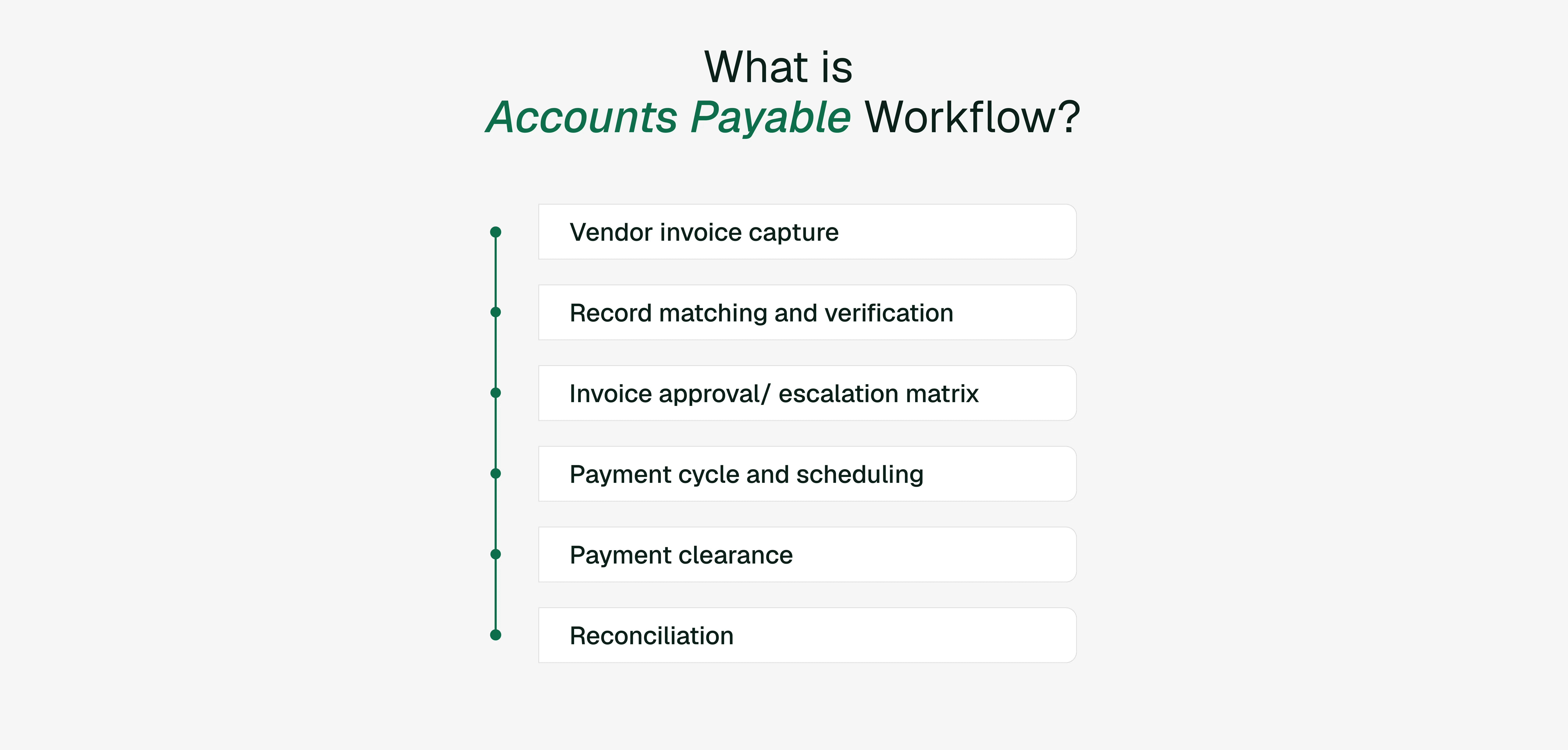
Accounts payable workflow is defined as the process by which organizations process vendor invoices across stages of authentication, verification, payment and reconciliation.
For example, a manufacturing company’s accounts payable workflow could be:
- Invoice capture through the ERP system.
- Accounts payable picks it up for 3 way matching.
- If PO is a match, GRN is pulled.
- If the GRN match is a success, then further approvals are needed.
- Team leads and finance head gives sign-off or highlights issues.
- If sign-offs are complete, payment is scheduled based on cycle.
- Final payment, updating vendor.
- Reconciliation and book closure.
Such workflows include setting exception handling protocols, such as document mismatch, issues related to vendor communication, internal document errors etc.
The biggest benefit of having a set workflow for accounts payable is that it provides a template for streamlined operations. It helps set cross-team collaboration protocols, keeps stakeholders alerted and provides accounting teams with preset instructions on how to handle various scenarios.
Related: What is Accounts Payable Management?
Accounts Payable Workflow Process: Key Stages
Accounts payable workflow includes a series of actions across various stages, let's dive into each:
- Stage 1: Vendor invoice capture
The first step in the workflow is defining how the vendor invoice will be captured and stored. In enterprises, the ERP system is the gateway that captures this information when the vendor sends it via email. In small/ mid-sized firms it may be a specific finance or accounting software that performs this function or it may be manual as well.
Either way, it needs to be picked up by the accounting team for further processing.
- Stage 2: Record matching and verification
Once the invoice reaches accounting, the immediate check is for header details such as the PO number it is referencing. If the PO is found, then an immediate 2 way match can happen between PO and invoice. In case of a 3 way match, the GRN is the next item to locate and match. If all matches are successful down to the line items, then it is sent for approval. If there is a mismatch, the payment is kept on hold and the issue is escalated.
- Stage 3: Approval/ escalation matrix
The approval matrix is a rule book of who gets to view and clear invoices and in what capacity. It sets the framework of authorization through sign-offs by finance and operational stakeholders. The exact chain varies across companies, however the key aspect is to ensure that the right system of communication and collaboration is in place for it to work seamlessly.
- Stage 4: Payment cycle and scheduling
Typical vendor payment cycles are monthly, and in some cases quarterly. Once all approvals are complete, the accounts payable team schedules the payment, but clears it at the due time. This also ties into accounts receivable cashflow which feeds into monthly working capital.
- Stage 5: Payment clearance
Payment is cleared on or before the actual due date using pre-approved modes of payment such as online bank transfers or using the vendor’s online gateway. The transaction gets recorded in the finance/ accounting system which is used in the reconciliation and closure phase.
- Stage 6: Reconciliation and book closure
Reconciling and closing the books is the final stage of the accounts receivable workflow. During this period, all documents - invoices, purchase orders, payment receipts, bank statements, vendor statements etc are matched again. If no discrepancies arise, then the books for closed else the matter is investigated. This is key for financial statements, business decision making and audit-readiness.
Related: What is Invoice Management?
Importance of Accounts Payable Workflow for Businesses
Accounts payable workflow sets the cornerstone for effective and optimal functioning of the payable process. Here are the key factors that makes this workflow so important for business operations:
- Timely vendor payments and penalty prevention
Well-defined accounts payable workflow is the cornerstone for timely vendor bill clearance and avoiding late fees and penalties. Furthermore, timely payment is key to ensure long-lasting vendor relationships that secures the company’s supply chain requirements and effective functioning to generate sales and revenue.
- Detection and surfacing of errors and fraud
Errors in documentation and billing when unnoticed can lead to significant financial leakages. Processes that verify invoices, match them with PO and GRN, authenticate accuracy of items being billed etc, are built to detect issues and correct them. Fraud attempts also get caught by the same process, with thoroughness and accuracy being key assets.
- Application of financial checks and control
For enterprises financial checks and balances are a key method of applying basic security controls on the flow of cash. Approval chains, document checks, reconciliations etc are key methods of applying essential financial hygiene checks on all cash outflow.
- Framework for financial operations scalability
As businesses grow, so does their need for supplies and paying them using secure methods of verification and payment. Accounts payable workflow creates this framework for scalability without entering chaotic and error-prone phases which happen quite often with growing businesses that don’t have a well defined payable process in place.
Related: What is Expense Management Automation?
Best Practices for Managing Accounts Payable Workflow in 2026
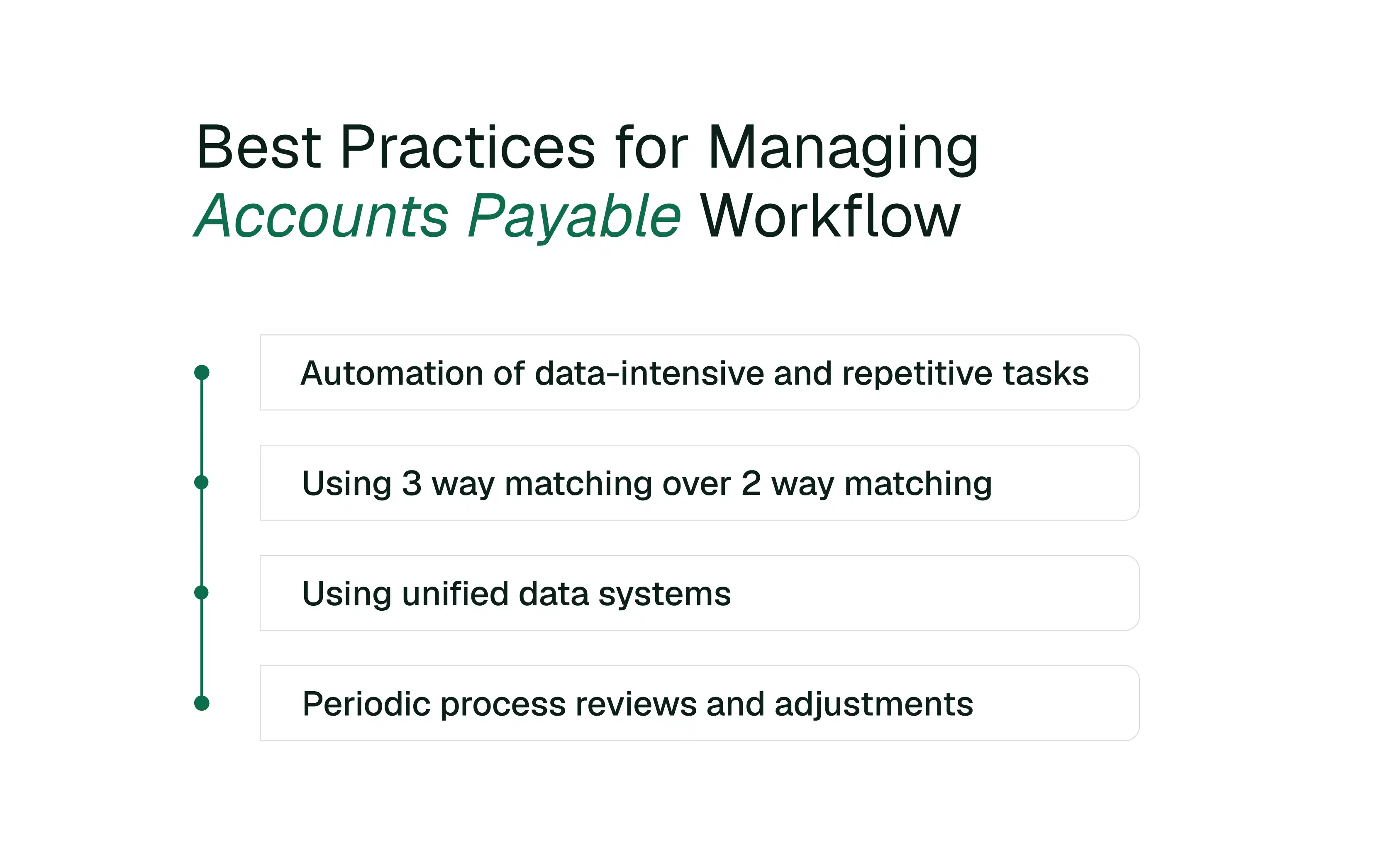
Here are the key best practices to create and manage an efficient accounts payable workflow in 2026:
- Automation of data-intensive and repetitive tasks
Heavily manual and data-intensive tasks such as document scanning, data entry, document retrieval, record matching etc can all be easily automated today using software. These processes can be strengthened and refined with human oversight, but a bulk of the manual work can be done exponentially faster using automation. Instead, finance teams can be focused on giving more time and consideration to core decision making and driving glitch-free business operations.
- Using 3 way matching over 2 way matching
While close-knit small organizations/ startups can manage payable workflows with a 2 way match, larger enterprises may face challenges without including a GRN into the matching process. Without it, leakages surrounding what was ordered versus actually delivered, quality issues, defects etc can creep in, without vendor accountability surfaced.
- Using unified data systems
Data fragmentation is a key reason for fragile operations in finance. When data is kept in silos, updates also happen in silos with the full picture never available till it is too late to take effective remedial action. A unified data layer like the one that Rever creates gives a complete picture of payable and other finance operations, allowing teams to work on real-time, updated and complete data sets.
- Periodic process reviews and adjustments
Accounts payable workflows need to reflect the realities of financial operations of the business, with core processes being updated and aligned to changing requirements. Periodically, all processes, systems and methodologies need to be reviewed and implemented with incremental updates to prevent making drastic changes when done after long periods.