.webp%3Fprefix%3Dhero&w=3840&q=75&dpl=dpl_q1TMgR72gvQyebNDfGr7kznZthgC)
What is Invoice Management?
Invoice management is defined as the process by which a vendor invoice makes its way through the organization’s approval and payment workflow, including invoicing channel, authentication, dispute resolution, payment clearance and financial reconciliation.
For example, a manufacturing company gets a supplier invoice every month for raw materials. This invoice is first received through email, which is captured by the enterprise ERP, picked up by accounting, record matched with purchase order and GRN in a 3 way match, approved by team leaders and finance head and then processed for online payment. The accounting team then updates the ledger and closes the books after reconciliation.
In the above process, if there was an issue during the match process or any other stages of verification and validation, it would be escalated based on the set protocols and payment would be kept on hold till resolution.
This whole process of how the invoice is first captured, verified, how exceptions/ issues are handled, escalation matrix, final payment process, updating financial books is encapsulated in invoice management.
Related: What is Invoice Approval Workflow?
Invoice Management Process: Key Components
Invoice management processes span across capture and validation, all the way to reconciliation and closure. Let's look at each component and how it fits into the larger process:
- Invoice capture
Invoice capture is the first step in the management process. This defines how an invoice is expected to be sent by the vendor and how it will be picked up for processing by the team. This requires communication with the vendor and collaboration among teams.
Most companies today follow a fully digitized process for receiving and capturing invoices. Typically, invoices arrive by email as PDF attachments, complete with specific fields of information that are mandated as per company policies and regulatory standards.
- Invoice validation
Once an invoice is received, it is picked up by the accounts payable team for validation and processing. Invoices are generally validated using 2 way match or 3 way match methods. If the document match is a success then invoice is sent for further approvals by team leads, in case of a mismatch, it is rejected and requires resolution through communication with the vendor.
- Approval
The approval workflow is unique to organizations, depending on size and industry. Typically the team who uses the vendor products, finance and operational leaders are involved in the approval process.
- Escalation matrix
In case of any disputes with the vendor or exceptional cases, a pre-set escalation matrix needs to be in place to handle such situations. This may also include legal teams and senior company leadership, depending on the severity of the escalation.
- Payment clearance
Vendor payments are cleared by accounts payable team using a pre-defined and agreed upon method. Online bank transfers are the most common and convenient method here for both parties. For international payments, regulations are always to be checked and the suitable payment methods to be arranged.
- Reconciliation and closure
While the ledger is updated once the payment is made, the books are closed only after reconciliation with vendor and bank statements. Done manually, this process may be monthly or quarterly; with automation platforms like Rever, it runs continuously.
Related: What is Accounts Payable Automation?
Importance of Effective Invoice Management for Businesses
Effective invoice management is the cornerstone for proper functioning of accounting, finance and vendor management. Here are the key factors that make it an important business process:
- Invoicing error/ fraud prevention
The most important contribution of effective invoice management is in significantly minimizing or fully preventing invoicing errors or fraudulent invoicing attempts. This includes training staff, having the right response and escalation protocols, using 3 way matching etc. Even better is using automation software like Rever, which applies verification, checks and controls continuously.
- Avoiding late fees and vendor relationship strains
Vendor penalty fees for payment delays can be a big contributing factor to avoidable expenses, especially for enterprises. Invoice management processes ensure that vendor invoices are processed through the system of checks and protocols in time to ensure payments are cleared within the stipulated period.
- Budget and resource utilization analysis
Invoice management includes analysis of invoices incurred by teams and departments, which reveal areas where expenses are piling up close to budget threshold or may potentially breach it. This can help managers delve into the actual utilization of these resources and cut down where it's not really needed.
- Working capital and cash availability analysis
Invoice bills are a deduction on working capital, and clarity through effective analysis is needed to ensure that they are accurately reflected in cashflow and financial analysis reports. Trend patterns of invoices play a key role in overall forecasting of financial health of the organization.
Related: What is Accounts Receivable Automation?
Best Practices for Invoice Management in 2026
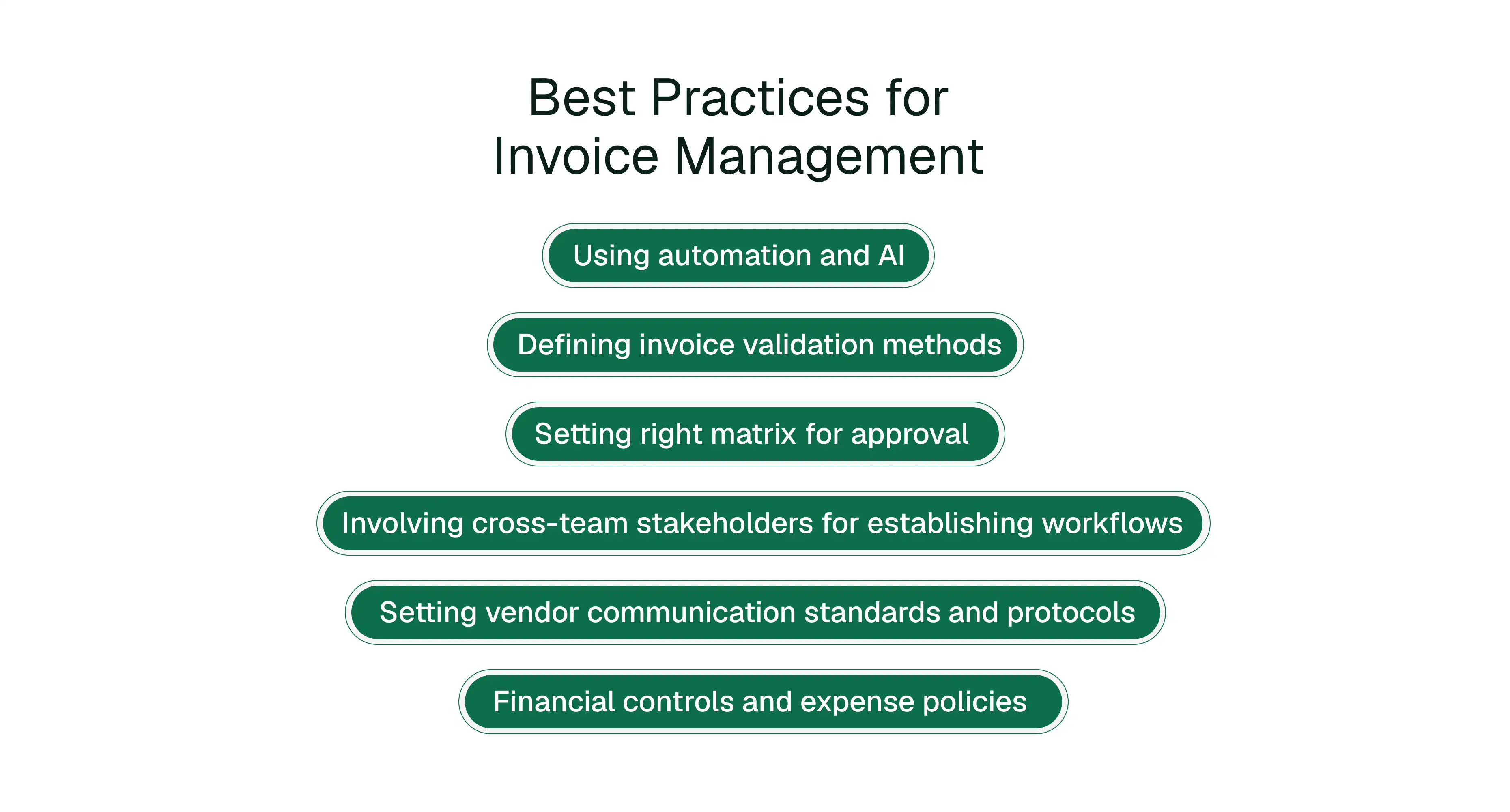
The invoice management landscape has been evolving, simplifying and becoming more efficient for years. Here are the key best practices for managing invoices in 2026:
- Using automation and AI
Invoice automation can take repetitive work out of invoice management processes such as invoice capture, record matching, validation and continuous reconciliation. This can go beyond just invoice management operations and encompass business finance automation at large.
See how Rever can do this for you ->
- Defining invoice validation methods
Invoice validation methods include how invoice will be matched for authenticity and accuracy by accounts payable, before approval matrix comes into play. A 3 way match method, which matches the invoice with both purchase order (PO) and goods received note (GRN), is the best way to ensure that goods/ services are not only ordered but also delivered as per expectations.
- Setting right matrix for approval
Approval matrix can be as simple as just being the finance head and lead of the team that placed the purchase order or can involve a much more sophisticated chain, depending on size and complexity of the organization, especially for publicly listed companies. Whatever the case might be, the goal is to ensure that the right stakeholders are involved, with the process documented and followed.
- Involving cross-team stakeholders for establishing workflows
Invoice management typically requires the involvement of accounts payable, finance at large, leads of teams who have the goods/ services requirements, and operations head/ COO. It is therefore key to ensure that cross-team collaboration and dispute resolution protocols are in place to ensure smooth functioning of invoice management and supply-chain at large.
- Setting vendor communication standards and protocols
Communication with vendors about invoicing format and sharing methods, payment cycle and method of payment, expected standards and channels etc, are key to ensure that companies have reliable, scalable and long standing trusted relationships with vendors. This is key for timely fulfillment of supply chain requirements for their own operations and revenue generation.
- Financial controls and expense policies
Financial checks, validation and budget controls are applicable to anything that touches money in a business. Invoice management is a core aspect of accounts payable, and is typically owned by the finance/ accounting team. They are responsible for effective end-to-end process management and using secure methodologies of checks and balances on all payables.


