
What is Accounts Receivable Automation?
Accounts receivable automation is defined as the process of using software to deliver complete or partial execution of data-intensive and repetitive tasks in the department. Examples of key areas of accounts receivable automation include customer credit checks, payment reminders, invoice generation, payment processing, reconciliations etc.
Automation capabilities will depend on the sophistication of the software being used and its integration availability with other technologies being used. Careful consideration is needed to pick this technology that fits well with your existing accounting and finance tools. These can be your enterprise resource planning (ERP) platform, customer relationship management (CRM) software, accounting tools etc.
Accounts receivable automation carries many benefits for enterprises such as increased data validation and accuracy, role-based alerts on issues and anomalies, reduced sales-to-cash period, accurate and timely customer communication on invoices and dues, elimination of manual errors, much better cash flow management, increased focus on customer relationship management over performing mechanical functions etc.
For example, an IT services company closes a new deal with a 1 year contract, billed monthly. The accounts receivable automation system automatically detects this and based on the billable it generates invoices at the end of each month and schedules them for delivery to the customer at the beginning of the next month. It sends reminders for any missed payments, and once the cash is received, the ledger is updated and reconciled. The accounting decision makers only need to verify and approve, the actual operations are automated.
The importance of human oversight for any financial software is also equally critical, and leaders need to ensure that final review and decision making regarding payments is owned by the right people.
Related: What is Accounting Automation?
Key Components of Automation in Accounts Receivables
There are several micro areas of functions within accounts receivables that need to be looked at and evaluated for automation:
- Data ingestion and validation
The first area of automation is the data ingestion, where the automation engine reads and gathers all the data across integrated systems such as ERP, CRM and finance tools. Softwares typically use optical character recognition (OCR) to scan documents and detect data.
At the same time, this data should be validated by the engine through record matching and checks for accuracy. This validation process is key to ensure that the ingested data is error free at the earliest stage of receivables automation.
- Customer credit management
The automation software should be capable of checking customer credit information available to the company and interpret the data to assess credit worthiness. Alerts should be sent to key stakeholders in case of anomalies or issues with existing credit limits for supplies.
- Invoice generation and delivery
The system should be able to detect sales and delivery data and automatically generate periodic invoices and deliver them to the right people via email or other appropriate integrated systems.
The system should send payment reminders in preset intervals to keep customers attentive on due payments.
- Payment detection and logging
Once the payment for delivery is received, the automation software should be able to detect it, analyze and match with invoice for accuracy and log the information to close the book.
- Discrepancy and deviation detection
If any discrepancies arise during payment receival, the system should be able to detect and escalate based on the set matrix. There should also be continuous scans for any deviation in receivables trend at large which may indicate potential overlooked issues.
- Workflow and escalation matrix
Proper workflows of receivables process, approvals and escalation should be set up in the automation engine. It should be able to follow this path and deliver role-based, proactive and preemptive insights to the right people, before issues become fire-fights.
- Analytics and reporting
Accounts receivable automation should include generating real-time analytics and reports from the most updated information available across all connected systems.
Related: What is Accounts Payable Automation?
Accounts Receivable Automation Process: Best Practices for Implementation
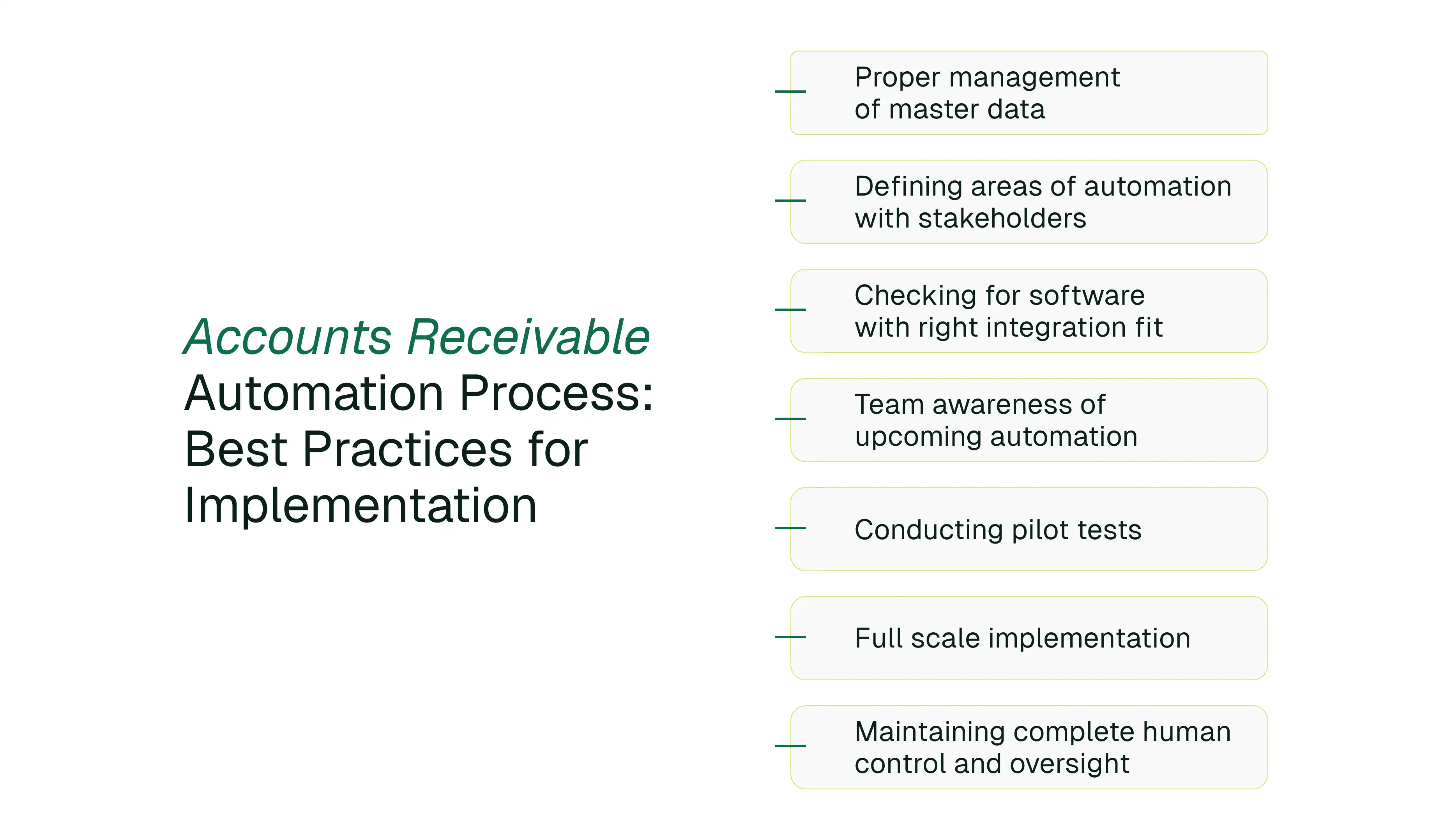
Automation of accounts receivable has some key components that form the full process of implementation and management:
- Step 1: Proper management of master data
The first step to effective implementation of receivables automation is to double check the information in your master data systems that will be ingested by the automation software. While the system itself should be able to detect any underlying issues with the data, the best practice is to ensure completeness and accuracy before supplying this information for automation.
Routine inspection of the master data even after ingestion ensures that basic data infrastructure is accurate, complete and error-free.
- Step 2: Defining areas of automation with stakeholders
As we saw above, there are several areas of automation possible today, especially using an AI-native platform like Rever. The organization should carefully consider all areas of potential automation based on current volume and near-future scaling, and select the most impactful functions.
- Step 3: Checking for software with right integration fit
A key consideration for adding any automation system is to understand if it integrates well with your existing core systems. This is the cornerstone for data ingestion and interoperability across systems to deliver expected automation results. Systems like Rever go a step further by first authenticating the data at the time of ingestion and then unifying it under a single layer, without ever editing your original data source systems.
Apart from this, all the areas of automation decided by the stakeholders creates the key column of checklists.
- Step 4: Team awareness of upcoming automation
The users of the automation engine and people whose work will get affected by the outcomes it produces, both need to be fully aware of the capabilities of the software addition. Furthermore, ensuring that the software vendor has sufficient resources and training available can help avoid adaptation challenges.
- Step 5: Conducting pilot tests
Before full scale implementation of critical software that closely touches money, it is always a good idea to first run a pilot test on desired capabilities and output, and thoroughly test. Key stakeholders need to be involved in the pilot run, seek adressal/ resolution plans from vendors where needed, ask for any specific feature additions and only then proceed with final purchase discussions.
- Step 6: Full scale implementation
After one or more successful pilot tests, the receivables automation software can be implemented in full scale. Even now, the first few days will need close monitoring and verification of the results being produced. Once the team is confident of its functionality, the oversight should be ideally handed over to a single or multiple team members.
- Step 7: Maintaining complete human control and oversight
Accounts receivable automation, especially when powered with AI, brings in bountiful benefits across functional areas and processes. It is however important to always note that this is a very core financial process that has the critical impact on revenue and financial health of the organization. Human oversight is key to ensure that the system does what it is meant to, and never modify any data that it is not supposed to.
Rever never writes back to your source systems in the first place and is “read-only”. It creates its own unified data lake and uses it to give users decision Nudges and evidence based Agent responses.
Related: What is Finance Automation?
Benefits of Automating Accounts Receivable Tasks
- Data verification and authentication
An AI-native finance automation system like Rever authenticates and verifies the data through checks and balances before any ingestion. This already acts as a data validation layer even before the data enters the automation engines. Inside the system, there are now more engines for continuous authentication and application of controls.
- Reduced order-to-cash periods
Through automation of invoice generation and delivery, reminders, online payment channels, receipt capture and logging, the overall period of customer order to final payment of cash can be significantly reduced.
- Timely and templatized customer communication
The receivables automation engine can follow a verified and templatized workflow for customer communication and ensure precision down to the minute. This helps avoid any manual errors or delays with the assurance that customers will be accurately updated on due payments.
- Elimination of manual errors
Automation’s biggest benefit across functions is the elimination of manual errors through automated data verification and validation that runs continuously, as is the case with Rever.
- Continuous reconciliations and closure
With Rever, reconciliations run continuously and books close automatically with close day becoming a mere review day for the team. Instead of making it a weekly/ monthly task, automation enables continuous record matching, reconciliation and closure, all happening in real time.
- Better human talent allocation
Human decision making talent is precious and unique, and should be treated as such. Instead of having job profiles that are repetitive and manual, finance roles can now evolve into more interesting, decision-oriented profiles with automation lifting the weight of daily data-intensive tasks.
- Significant improvements in cash flow forecasting and management
Through realtime data capture, self-service payment portals, logging receivables, reconciliation and closure, the automation engine enables finance teams to access the most up-to-date information, rather than data that was last reconciled weeks ago. This is a significant boost for cashflow management and more accurate forecasting.
- Role-based alerts on issues and anomalies
Systems like Rever have the capability to detect anomalies and trend patterns, and send role-based alerts with appropriate actions in the form of Nudges. Based on who can actually act on it, the system delivers proactive and timely Nudges with financial impact, and tracks it to its conclusion.


