What is Finance Automation?
Finance automation is defined as the process of using software to perform certain financial tasks without requiring human intervention, within an organizational framework.
Typically, such tasks are repetitive and data-intensive, making them suitable for automation. For example, document scanning and verification, data authentication, 2 way/ 3 way record matching, invoice management, reconciliations, finance report generation etc.
Automation in finance can play a key role in the delivery of much faster decision-making capabilities, human error minimization, financial data integrity, alerts on inefficiencies, early stage anomaly detection, uncovering trend patterns, real-time reconciliations and forecasting and much more.
Besides the enterprise operational enhancements, it also helps create effective finance teams where smart decision making becomes the key responsibility rather than performing intense manual tasks. Automation of repetitive and uncreative tasks also makes job roles and functions more attractive to candidates and employees.
Related: What is Accounting Automation?
Key Components of Finance Automation
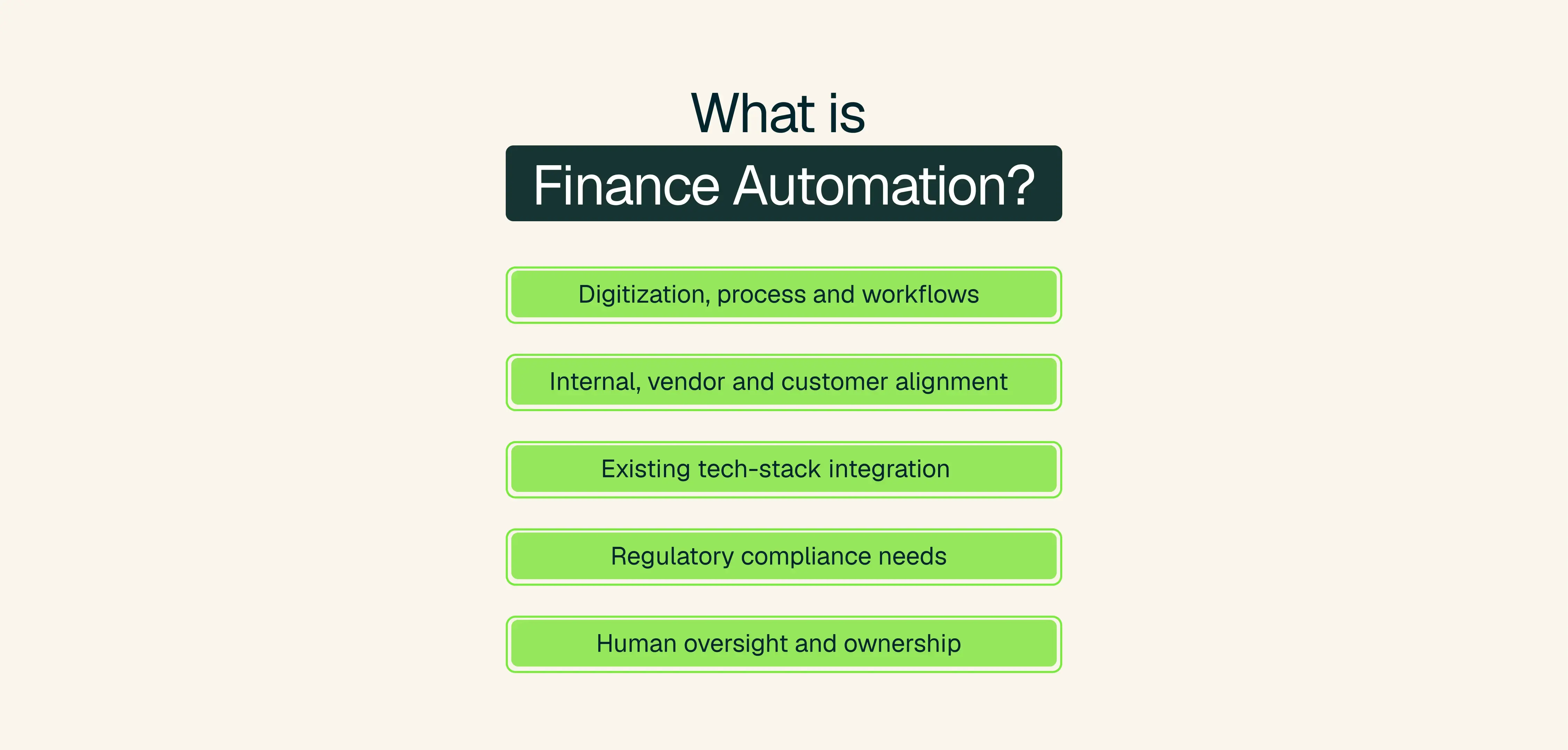
Effective financial automation relies on some key components to deliver maximum functionality for tangible enterprise impact. Let's dive into each:
- Digitization, process and workflows
For any automation, the first step is to ensure that the existing and historical data is digitized before it can be ingested by any automation engine. The automation system also needs to align with your existing financial practices and processes such as vendor invoicing, payroll, customer billing, reconciliation etc.
For this to work seamlessly, it is key to have clear process definitions, along with exception handling procedures wherever possible. Having clearly defined workflows provide more precise and granular steps of cross-functional operations, such as handover, approval and escalation matrix etc. These structures enable finance automation systems to follow the approved definitions and workflows, with human input being required only at key stages of decision making.
- Internal, vendor and customer alignment
For any new enterprise system to deliver maximum functionality, it is critical to ensure proper adaptation and usage of the software by team members as intended. This can be ensured through adequate training, resolving queries and internal governance.
Vendor and customer alignment is key to ensure that any document being generated by them follows the required standards and has all the necessary details for data ingestion, scanning and processing by the automation engine. Furthermore, keeping them updated about automation helps avoid confusion around system generated messages and reminders.
- Existing tech-stack integration
Invariant of the specific automation software that you might pick, the key is to ensure that it integrates with your existing enterprise platforms such as ERPs, CRMs, accounting tools etc. Another consideration is to take into account the integration with any future tools that you are planning to buy and has relevance to financial automation.
- Regulatory compliance needs
Compliance requirements can differ across geographies and the automation software needs to have the full gamut of compliance features across your business zones. The system should be able to dynamically adhere to compliance needs based on operational locations and match them with required regulatory standards.
- Human oversight and ownership
For any automation tool, human ownership and oversight of the functionality of the software is a key to ensure that it functions the way it is meant to without errors or overreach. While automation tools are well designed to stay true to their core functions, with any software it is never fully guaranteed that occasional errors won't creep in or might suffer from issues in connected systems. Having human supervision ensures that such issues are quickly identified and taken up for resolution.
Types of Automation in Finance in 2026
- Accounts payable automation
Accounts payable automation encompasses post-service/ goods delivery payments to vendors across enterprise operations such as supply chain, software and hardware, real estate etc. The automation system is expected to capture, scan and match vendor invoices to verify authenticity and accuracy, and keep the final data available for human checks and payment processing.
- Accounts receivable automation
Accounts receivable automation matches deal values with expected cashflow from customer billings, sending invoices and reminders to customers, and keeping a record of missing or delayed payments.
- Expense management automation
Automating expense management encompasses receipt capture, reimbursement validation, approval routing, policy validation and alerting for manual intervention when needed. The goal is to increase compliance, reduce errors and give finance teams more accurate visibility into the cost of doing business. Learn more about expense management automation.
- Payroll processing automation
Automation in payroll processing can be expected to cover the key functions of employee salary processing, disbursement of benefits and reimbursements, while remaining fully compliant. Such automation typically requires integration with HRMS, attendance management and other tools used by HR and employees.
- Reconciliation automation
The biggest benefit of automating financial reconciliation is that software can perform these tasks in real-time and continuously, rather than using a periodic time slot such as monthly or annual reconciliation. Automation software like Rever performs immediate reconciliations of internal transactions with available external data from statements generated by banks, customers, vendors, payment tools etc.
This continuous reconciliation capability helps ensure that anomalies/ issues can be detected in real-time and immediately flagged for human attention.
- Financial analysis, forecasting and reporting automation
A key part of data-intensive financial operations is tasks related to generating reports through analysis and forecasting. Here, automation enables real-time access to understand immediate status of financial ledger, revenue goals, expenses, emerging internal trends etc.
As this process requires no manual data preparation when done through automation, it helps accelerate decision responses to events and resolve or mitigate them before they turn into real problems.
See how Rever can do this for you ->
Key Enterprise Benefits of Financial Automation
- Freed-up human talent from repetitive manual tasks
Financial automation enables the preservation of precious human decision making talent for functional areas that actually require it, rather than wasting it on repetitive and manual labour work of data entry, record matching, reconciliation, report generation etc. This talent can now be reassigned to more decision-oriented tasks that require real human awareness and intuition.
- Increased data confidence through error-minimization
Effective financial automation not only minimizes human-driven errors, but also authenticates the underlying data through rigorous analysis and record matching. It surfaces underlying issues and flags anomalies for resolution, thereby strengthening the integrity of enterprise data and bolstering confidence for analysis and outcomes.
- Real-time checks, controls and analysis
Financial automation enables real-time data validation, reconciliations and error-detection, and enforces policy controls without needing human intervention. Such tools typically have an always-on analysis engine that delivers real-time reports based on the most updated available information in the enterprise database.
- Cost control through reduced inefficiencies
Inefficiencies are a key factor in financial overhead, which without a continuous analysis and alert system, can easily get ignored, remain unidentified or get overlooked. Financial automation systems can perform real-time checks to identify and surface areas of resource underutilization, budget conflicts, leakages, redundancies and financial underperformance, and alert the right people to take action.
- Ease of financial operations scaling
Automation of manual financial operations gives enterprises the flexibility to scale without hitting operational labour barriers in order to keep up with transactional volumes. Such systems are capable of maintaining pace of delivering checks and balances, policy enforcement and compliance needs, at all times, invariant of the scale of business operations or changing regulatory requirements.
Best Practices for Implementing and Managing Finance Automation
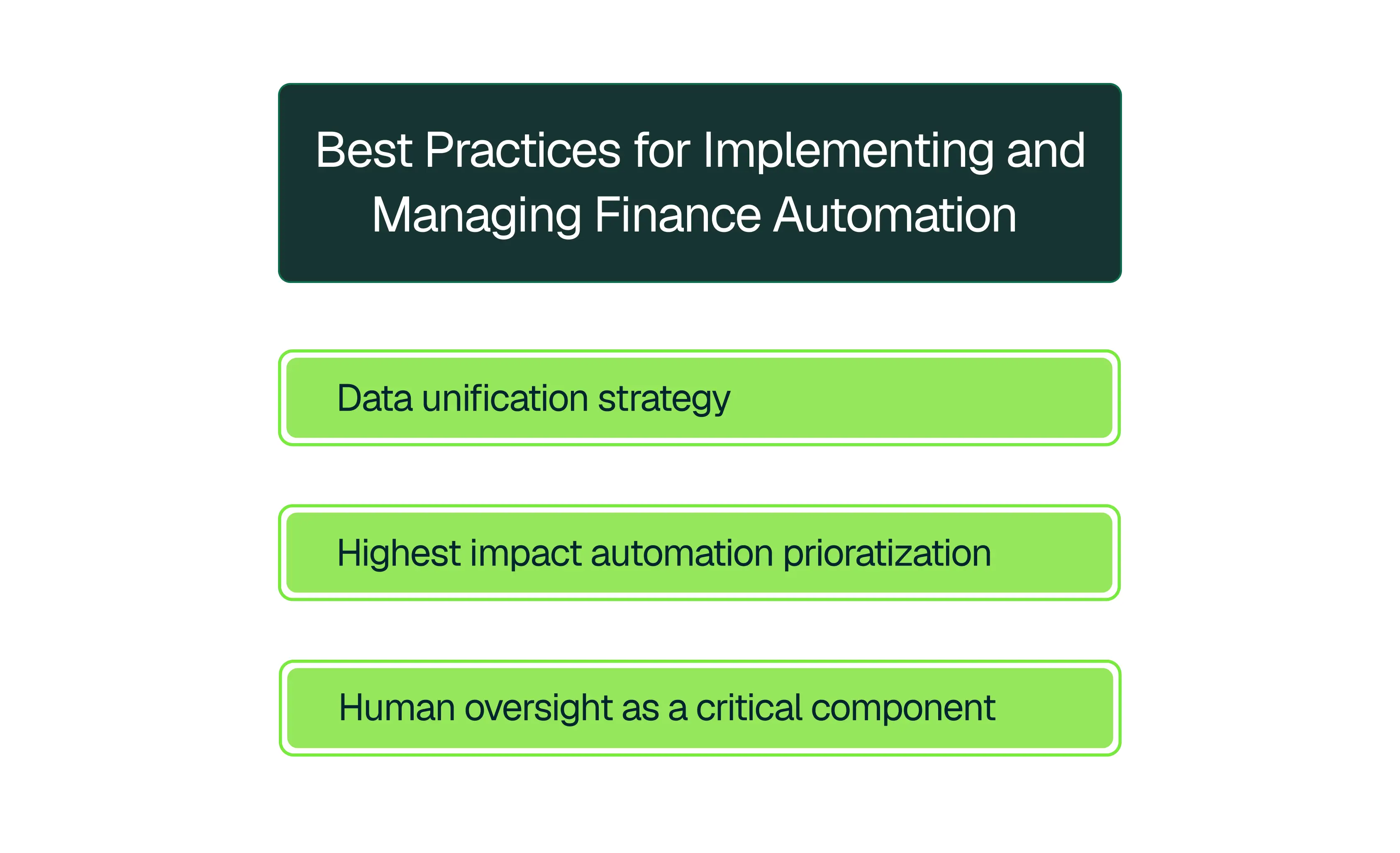
- Data unification strategy
At the heart of any effective automation is unification of data from fragmented states. When data lives in disconnected silos, it minimizes analytical capabilities, increases redundant information flow and prevents identification of underlying anomalies and errors. Data unification is also key to ensuring proper data formats for interoperability across connected systems in the enterprise tech stack.
- Highest impact automation prioritization
When considering financial work functions for automation, prioritize tasks that will deliver the highest impact, which are typically tasks that require significant manual labour, are repetitive and data intensive. For example, document scans for accuracy and completeness, 2 way/ 3 way record matching, cross-record reconciliations, payment reminders to customers etc.
- Human oversight as a critical component
No matter the depth of automation, human oversight is always needed to ensure quality checks on proper working conditions of all system connections. For example, ensuring the automation engine is functioning as expected, application of all tiers in access controls, functioning of policy enforcement mechanisms, meeting of compliance needs etc.