
What is Financial Reconciliation?
Financial reconciliation is defined as the process of tallying internal financial transactions and statements with external data sources with the final goal of closing the books. This external data can be in the form of bank statements, vendor statements, customer statements etc.
The goal of financial reconciliation is to ensure that there are no discrepancies between internally maintained records and actual reality of company transactions and general ledger of the company. To achieve this, reconciliation takes place across all aspects of accounting and finance - accounts payable reconciliation with vendors, accounts receivable reconciliation with customers, payroll reconciliation with employee records, bank reconciliation with internal statements, and inter-company reconciliation among subsidiaries and business branches.
For example, a quarterly reconciliation of accounts receivable includes checking every customer billing generated by sales teams with customer statements and bank statements to ensure that actual cash received from customers is in line with reality in the bank and not just a number in their own books.
Reconciliations are the essential pre-requisite to book closure on any transaction, be it as inflow or outflow. They form the most essential pillar of financial checks and controls for accurate assessment and reporting of financial health of the company.
Related: What is Finance Automation?
Key Steps in Financial Reconciliation
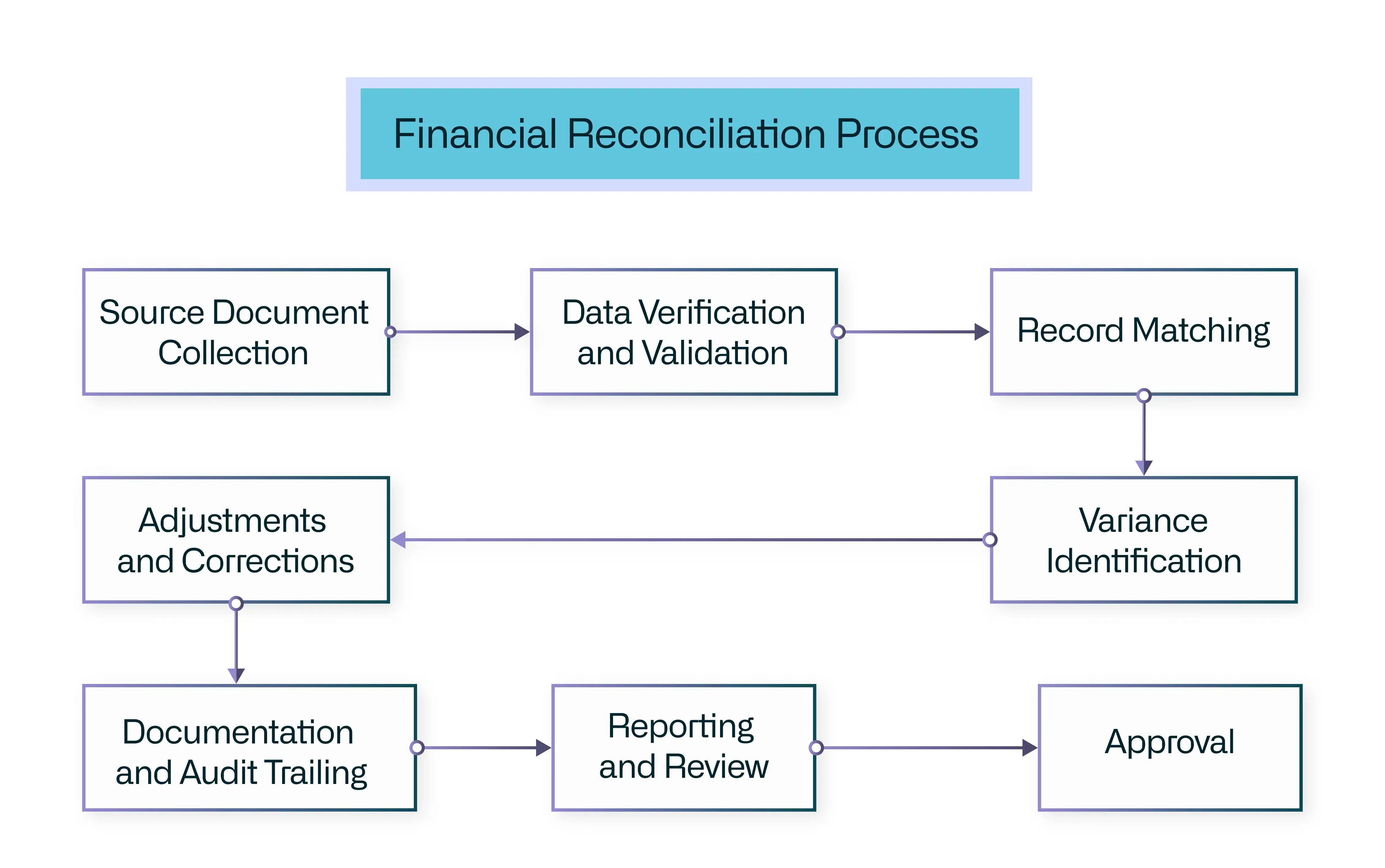
Financial reconciliation starts with data collection across transactions and ends with the closure of books or highlighting of issues for reaolution. Here is how it unfolds in key steps:
- Step 1: Transaction-based data collection
Data on each financial transaction such as ledger reports, vendor invoices, goods received note (GRN), payroll data, sales data, etc, are collected. This data is typically maintained in an enterprise resource planning (ERP) system. However, for smaller firms, this information may exist in silos such as in CRMs, accounting software, and HR management software etc.
- Step 2: Data completeness checks
The data collected is first validated for completeness. In case of missing information or documents, the accounting team may engage with team leads and employees for resolution. For transactions for which internal data is missing, the books are kept open and issue is sent for further enquiry and resolution.
- Step 3: Record matching process
Record matching is where the actual reconciliation takes place. At this stage the accounting team is matching the internal company data with external sources of truth, such as the company's bank statement, vendor statements, customer statements etc.
- Step 4: Variance identification
If any discrepancies arise between internal and external data, then these line items are sent for enquiry and resolutions. For example, these can be a mismatch in customer payment, pending vendor invoices, excess payouts etc. Variances and discrepancies are handled through pre-set processes and protocols of enquiry and resolution and escalation happens as and when needed.
- Step 5: Adjustments and corrections
Adjustments in the company's ledger report are made based on final reconciliation results. For example, investment return expectation versus actual cash received, unpaid customer billings, uncleared vendor payments etc, need to be reflected in the new ledger and statements.
- Step 6: Closure
The result of financial reconciliation is the final closure of the accounting books on each transaction. However, areas of unresolved discrepancies are kept open till resolution. This reconciled financial report plays a key role in cashflow forecasting, budgeting and affects every aspect of financial planning.
Related: What is Accounting Automation?
Types of Financial Reconciliations
Financial reconciliation is a broad term that encompasses several smaller reconciliations. Whole these vary across organizations depending on internal structures and processes, here is a list of typical reconciliations that take place:
- Accounts payable reconciliation
Accounts payable reconciliation encompasses verification of any external outflow of cash from the company to vendors/ suppliers of goods and services. The process involves checking and rematching all such payments made to vendors with the company's actual bank statement, vendor statement and internal data.
- Accounts receivable reconciliation
Account receivable reconciliation includes verification of cash inflow to the company in the form of customer payments in lieu of goods/ services sold in credit. Here, all customer cash inflow data in the internal records are matched with bank statements and customer statements to ensure that the balance sheets are reflecting the accurate state of what has already been received, what is due and when. This creates the cornerstone of enterprise cashflow projections.
- Payroll reconciliation
Payroll reconciliation is conducted to ensure that there are no excess, pending or duplicate payments are made to employees, or employee benefit thresholds are crossed or any fraudulent attempts took place. Here, all HR and payroll data are matched with bank statements to ensure accuracy, and that HR systems are reflecting the actual, valid transactions.
- Intercompany reconciliation
Intercompany reconciliation is key for any large enterprise with subsidiaries and branches. This process ensures any inter-company financial transactions such as purchases, debts, asset transfers etc, are all in the books and reflects accurately in reports and balance sheets.
- Banking reconciliation
Banking reconciliation is the end-to-end process by which all internal financial data across functions is matched with actual bank statements of the company. This process ensures that every debit and credit data that is in the company ledger is reflected accurately in the bank statements. Any inaccuracies or additional transactions, be it in the statement or ledger are reported and investigated till resolution.
Books are only closed after full bank reconciliation in any of the underlying processes, be it receivable, payable, payroll or inter-company.
Related: What is Financial Close?
Importance of financial reconciliation for enterprises
Financial reconciliation is cornerstone for accurate financial reporting and staying ready for any external audits. Here are the key factors which makes this process so important:
- Confirms the company’s financial health
The primary goal of the elaborate and detailed nature of a financial reconciliation is to ensure that every transaction from the company’s account has the supporting document for validation. This ensures that the final result of the organization’s financial statement is an accurate reflection of the state of the company ledger and financial health.
- Identifies errors and lapses
The financial reconciliation process reveals any past errors that were wrongly logged, or any issues with the bank statements, vendor/ customer reports etc. The matching of the internal records with external data may reveal issues with the company’s own process or may even reveal issues with the vendor’s or customer’s books.
The result may require reassessment of employee training, better processes for collaboration between accounting and other departments, improved financial reporting practices etc.
- Keeps the books audit-ready
Being audit-ready requires a company to work like a self-cleaning engine. The goal is not for the auditor to expose issues in the company’s books, but rather to be in a state where no issues exist at any given time. For this to be the default state of the company’s accounting practices, regular financial reconciliation and air-tight accounting practices like 3 way matching, are cornerstone best practices processes.
- Ensures regulatory compliance of company transactions
Different geographies operate under different regulations, be it national, state or a group of nations like the EU. The company’s financial process already takes them into account, however, the degree to which they are being followed in daily practices is key to ensure compliance at any given time. The financial reconciliation process ensures that all set standards are being practiced and any lapses are reconciled.
Best Practices for Financial Reconciliation in 2026
- Establish a regular reconciliation schedule
Perform reconciliations at predefined intervals, such as weekly/ monthly/ quarterly, depending on transaction volumes and business requirements. Regular reconciliation helps identify discrepancies early, prevents the accumulation of unresolved issues, and supports timely financial reporting. A consistent schedule also improves financial discipline across the organization.
- Automate repetitive reconciliation tasks
Leverage reconciliation automation tools to match records, identify exceptions, and generate reports with minimal manual intervention. Automation improves operational speed, reduces manual errors, and enables finance teams to focus on investigating genuine discrepancies rather than performing routine comparisons.
- Data synchronization across technology stack
By ensuring that financial records across systems such as ERPs, CRMs, HRMS, accounting software, etc are synchrinized through integrations. This consistency across connected systems minimize mismatches, significantly improves reconciliation accuracy and avoid false flags.
- Investigate and resolve discrepancies promptly
Treat unmatched transactions and exceptions as high-priority and prompt investigation to help identify the root causes. Faster resolution improves the reliability of financial records and supports accurate financial statements.
- Standardize reconciliation procedures
Develop standardized models of reconciliation templates, workflows and approval/ escalation protocols for better operations. Standardization ensures consistency across financial teams, simplifies training, and makes reconciliation activities easier to supervize.
- Ensure clear audit trails
Record every reconciliation activity, including supporting documents, adjustments, approvals, and exception resolutions. Comprehensive audit trails improve transparency, simplify internal and external audits, and provide evidence for regulatory compliance. They also make it easier to review historical reconciliations when questions arise.
- Continuously review and improve reconciliation processes
Periodically assess reconciliation workflows to identify opportunities for process improvements, automation enhancements, and policy updates. As business operations, regulations, and transaction volumes evolve, reconciliation practices should adapt accordingly. Continuous improvement helps maintain accuracy, efficiency, and compliance while supporting faster financial close cycles.


