
What is Invoice Approval Workflow?
Invoice approval workflow is defined as an internal accounts payable process, whereby a pre-set checklist of verifications are performed to validate a vendor/ supplier invoice. This workflow is triggered when the organization receives a vendor invoice.
For example, the supplier raises the invoice after delivery of the goods/ services based on an initial purchase order (PO) raised by the firm. These two entities - vendor invoice and the PO are matched against each other (2 way matching) to ensure that the invoice items are being correctly billed. If this match occurs accurately, then the invoice is typically sent for internal approvals, including the finance team and the team which ordered the product/ service.
For more advanced record matching, a goods received note (GRN) is also used, as is the case with a 3 way matching process.
At any stage of the invoice’s journey, if a discrepancy is found, then the payment is put on hold till there is a resolution.
An invoice approval workflow is not set in stone and varies across companies depending on size, industry and resources. However, invariant of factors, an invoice approval workflow is essential to ensure that any cash outflow to vendors is done through a well-recorded process that properly validates the invoice to be accurate and free of any fraudulent practices.
Related: What is Invoice Management?
Invoice Approval Workflow: Key Components
- Purchase order (PO)
The vendor invoice first and foremost goes through either a 2 way matching or 3 way matching process.
The purchase order is raised by the team or employee who required the product/ service from the vendor. This document contains all the data regarding the quantity, type, quality and pricing of the products required products/ services.
The PO document serves as a cornerstone for any tallying of invoices, and therefore needs to be as detailed as possible and should have a format set by the company's accounting/ finance team. Employees and team leads should ideally be trained to follow this format without deviances to ensure a proper document matching process with the vendor invoice.
- Goods received note (GRN)
The GRN is raised upon receipt of the goods/ services from the vendor and is submitted by the employee/ team lead who had raised the PO. The GRN is not mandated in all organizations, as it is not used for a 2 way match process, but is key for a 3 way match process.
For companies that use the more sophisticated 3 way match process, the PO and GRN are matched with the vendor invoice for added validation, versus the PO-only invoice match, as is the case with the 2 way match process.
- Vendor invoice
Vendor invoice is what triggers the whole invoice approval workflow once it reaches the company's accounting desk. This invoice typically carries a unique identification number that matches the PO for which the goods/ services are claimed to have been delivered.
Each company may require a specific format for raising invoices, and all vendors are kept informed and expected to follow the set format for easy matching and processing of payments.
- Matching method
- Invoice approval workflow involves the pre-set company processes and methods. As a standard, they involve the following key components:
- A 2 way matching process involves tallying the data in the purchase order against the invoice that has been raised.
- In a 3 way matching process, the vendor invoice is matched against the PO, and the GRN, to ensure that the goods/ services were actually delivered to the employee/ team.
Most large organizations use a 3 way matching process, as the added layer of assurance is required when the number of employees are large and spread across geographies. In such case a one-on-one quick meeting or email may not be possible for each invoice to verify delivery, and instead a written document in a set format is formally submitted for accounting verification.
Related: What is Expense Management Automation?
Invoice Approval Workflow Process: Key Steps
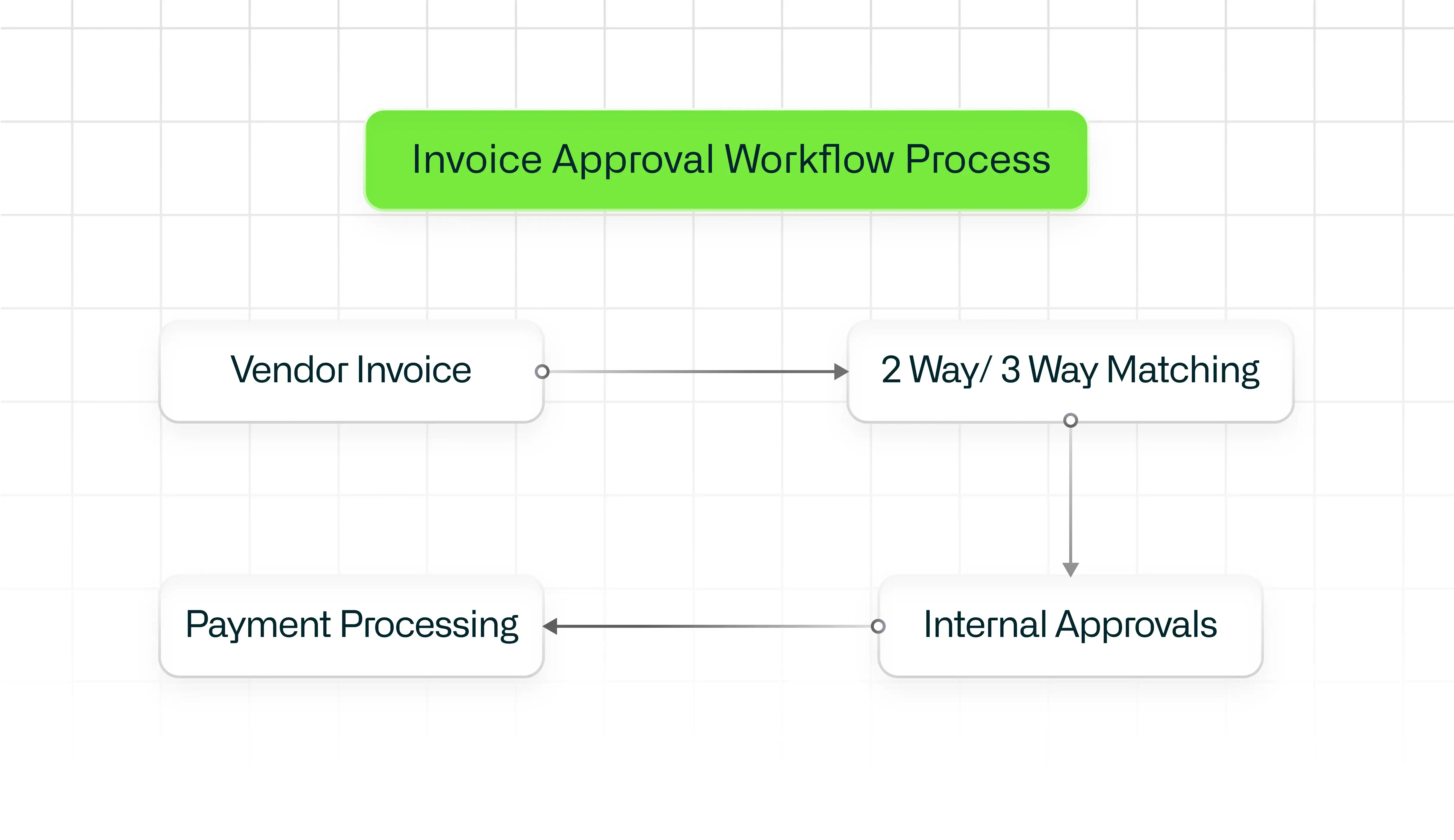
- Step 1: Receipt of vendor invoice
The entire invoice approval process is triggered when the organization recieves a vendor's invoice for post-purchase payment clearence. This is typically pulled from an enterprise resource planning (ERP) software which captures all vendor invoices in a centralized system.
In smaller companies the process may involve the invoice being raised to a team lead at first, and then forwarded to the accounting team for clearance. In such a process, a team lead level approval is already received by the accounting team for the invoice.
- Step 2: Document retrieval
Once the accounting desk receives the invoice, the related internal documentation are retrieved, typically from the company's enterprise resource planning (ERP) system or equivalent software. This documentation contains the purchase order (PO) and based on internal processes, may also be accompanied by the goods received note (GRN).
- Step 3: 2 way/ 3 way matching by accounting team
Depending on the set process, an accounting team may use a 2 way or 3 way matching process to validate the authenticity and accuracy of the invoice. As we saw before, for a 2 way match only the PO is required to validate the invoice, whereas a 3 way match requires a good recieved note (GRN) as well.
In either case, as long as there is a set 2 way/ 3 way match methodology in place, it is always a best practice to have set formats for PO, GRN and invoice.
- Step 4: Interval approvals
The exact process by which internal approvals happen varies from across organization's based on structure, size, industry, nature/ value of invoice etc. in some cases, an initial approval may have happened before the invoice reaches the accounting desk, and may later be sent for higher level or internal finance approval.
In all cases, typically a team lead is involved.
- Step 5: Discrepancy handling
Discrepancies may occur at any stage of the invoice approval workflow, be it in the early stages of document retrieval, 2 way/ 3 way match process or during internal approvals. In any case, if there is a discrepancy, the payment processing is kept on hold till the issue is resolved either internally or with the vendor, depending on the nature of the discrepancy.
Enterprises typically have pre-set workflows for handling any discrepancies with invoices, while smaller companies may have to learn and solve issues on the go as they may arise. In each case, the learnings from new situations should ideally work themselves into protocols and processes for handling them in future.
- Step 6: Payment processing and document archival
The final payment is processed once the vendor invoice passes all the required approvals. Typically this is executed by the company's accounting team and a confirmation of payment is validated with the vendor as well.
All documents related to vendor payment should be securely archived in a system, typically an enterprise resource planning (ERP) platform, accounting software or document management system (DMS).
Automating Invoice Approval Workflow with Rever
Rever is a financial automation software that integrates with your existing systems and retrieves, matches and processes vendor invoices. It fits and follows your set workflows and manages vendor invoices fully automatically, while keeping your accounting books updated and clean.


