
What is Accounts Payable Automation?
Accounts payable automation is defined as the process of using computing software to process vendor/ supplier invoices based on set workflows and processes.
This includes implementation of automated internal record matching with vendor invoices, with exception/ error handling capabilities.
For example, a vendor sends an invoice to a software company for monthly marketing. This invoice is typically received via an email. An accounts payable automation software, like Rever, then instantly and automatically picks up this invoice, scans and matches it with its respective purchase order (PO) in a 2 way match. Additionally, this match may involve the goods received note (GRN) in a 3 way match. It then follows any preset approval workflows and notifies respective team members. The results are then available to the accountant for further action.
The purpose of accounts payable automation is to remove the workload of manual and repetitive tasks from accounting and finance teams, with the results readily available for further processing that requires human eyes and decision making.
Key Components of Accounts Payable Automation
Accounts payable automation requires certain key components to be effective:
- Accounts payable automation software
Accounts payable automation software, such as Rever, are the cornerstone of automated orchestration for invoice retrieval, document scans, invoice data correlation with internal records, approval workflow and error handling.
An ideal software’s job here is to collect invoices, process them and keep everything ready for the accountant/ decision maker to take the final call.
- An existing ERP/ accounting software
Automaton works on top of existing traditional ERPs or other accounting/ finance software. They integrate with them, retrieve data as per requirement and feed data back into these systems.
For example, accounts payable automation in Rever is facilitated through seamless integrations with your existing financial software stack, such as Quickbooks and Xero.
- 2 way/ 3 way record matching
Any enterprise accounts payable protocol requires either a 2 way matching or a 2 way matching process to be adopted for it to be effective. This selection is the primary method of invoice document matching and verification of authenticity.
- Invoice approval workflow
Invoice approval requires a preset workflow of authorization to validate an invoice after record matching is successful. This workflow is then used in the automation software to orchestrate the sequence of approvals required.
Related: What is Invoice Approval Workflow?
Accounts Payable Automation Process: 4 Key Steps
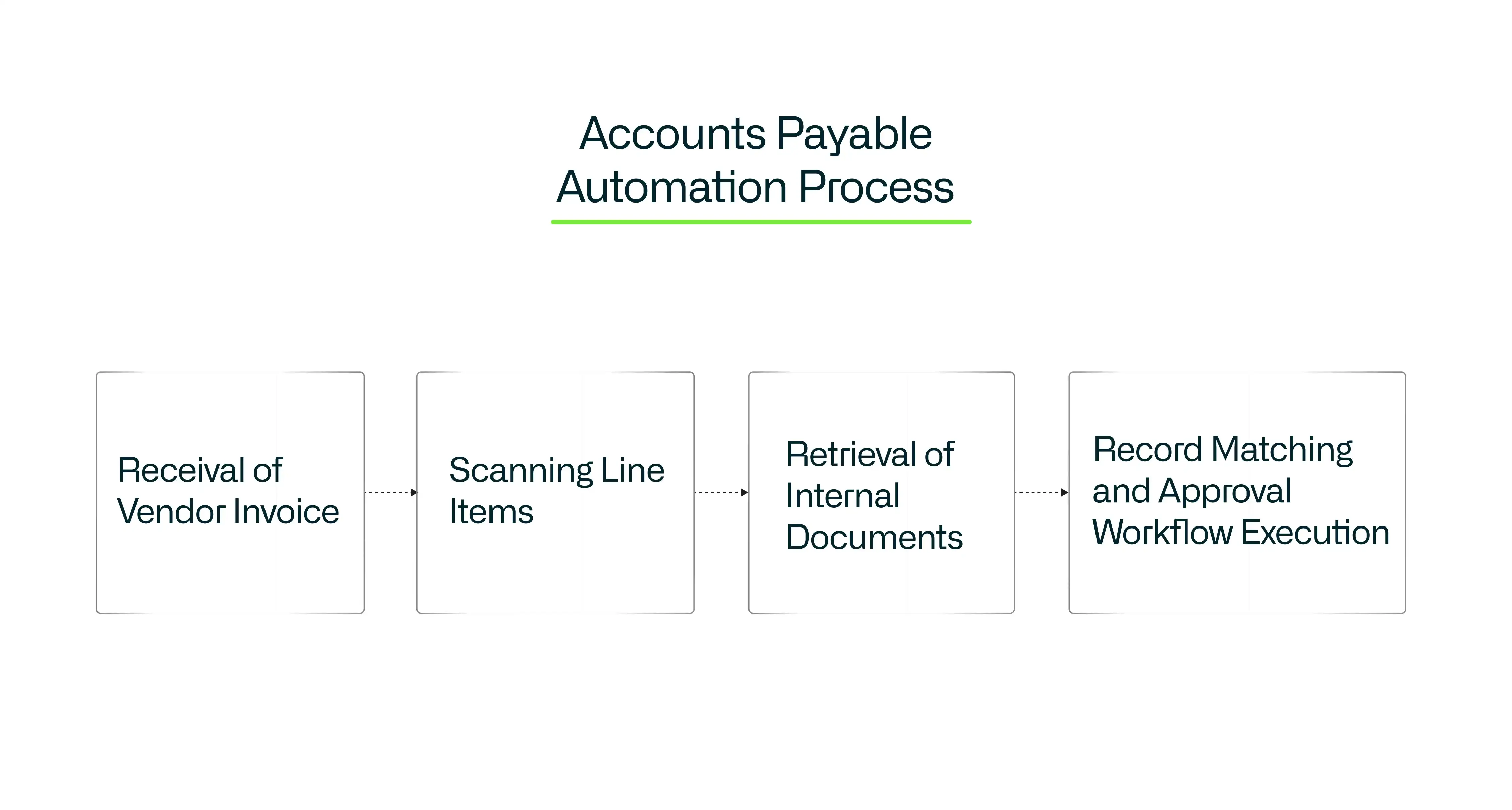
- Step 1: Receival of vendor invoice
Accounts payable automation software like Rever, are triggered when a vendor invoice email is captured and automatically begins to execute the sequence of checks and validations.
- Step 2: Scanning line items
The automation software executes a series of line item checks to first authenticate basic documentation of the invoice before proceeding with any record matching. This includes scanning for header items, company details, sender details, invoice line items etc. If the basic details required to process the invoice are present and accurate, further steps are taken.
- Step 3: Retrieval of internal documents
The accounts payable automation uses its integrations to retrieve required documents for scanning and matching with the invoices. It is automatically pulled from a system like an ERP or accounting platform where purchase orders and goods received notes are stored.
- Step 4: Record matching and approval workflow execution
Record matching is the core of accounts payable, and the most repeated and manual task. Record matching is preset, a 2 way match or a 3 way match process.
All documents are scanned line by line for accurate pin-pointed matching and if successful, the software then proceeds to execute sequential approval seeking from required team members for authorization.
With a financial automation software like Rever, this entire process is handled by the software and the results are kept ready for the account’s/ decision maker’s final review.
Related: What is Accounts Receivable Automation?
Benefits of Accounts Payable Automation
Accounts payable involves several manual and repetitive tasks that are cumbersome to the accounting/ finance teams. Automating this part of the process provides exceptional enterprise benefits:
- Freeing up manual accounting workload - cost and time saving
The core benefit of automating accounts payable goes to the finance and accounting teams who can be freed up from performing manual and cumbersome tasks. This enables them to focus on more decision-oriented tasks that require human intervention and leave the day-to-day payables processing work to software like Rever.
The final decision of whether to process a payment or not, still rests with the accountant/ finance team, thereby only getting involved once all the laborious tasks are done by the software.
In turn, this contributes to a large swathe of resources, time and cost saved for the team, as well as the company.
- Audit and compliance-ready data trail
Automation is highly data-oriented and leaves a validated data trail for cash outflow from the organization. All pertaining documents such as invoices, purchase orders, GRN etc, are scanned automatically and checked line by line for any discrepancies. This ensures that your accounting books are kept clean and clear with a compliance and audit-ready trail of financial outflow from the company.
- Real-time and insightful financial dashboards for stakeholders
Using an automation software like Rever comes with perks beyond just the cornerstone of automating tasks, it also provides deep insights on accounting and expense management. It gives a real-time financial overview of cash outflow, what’s done and what’s pending, and the overall financial ledger of the company, all in one screen.
- Increased vendor satisfaction
Vendors, while external, play a key role in organizational operations and success. There are significant benefits to ensuring vendors get paid correctly and on-time. Often a key cause of vendor grievances is untimely payments arising out of unclear processing time periods. By automating most of invoice processing, the accounting team also has ample time and bandwidth to raise any discrepancy concerns about invoices early on with vendors and execute payments on-time.


