
What is Invoice Approval?
Invoice approval is defined as an organizational process by which vendor/ supplier invoices are approved for payment.
For example, a vendor may raise an invoice after delivery of goods/ services. Once the invoice is sent to accounting for clearance, the set approval process is triggered. This may involve document matching with purchase order (PO) and goods received note (GRN), team lead signoffs, CFO signoff etc, based on protocols.
The invoice approval workflow itself may differ across organizations, certain standards for verification and validation are common among enterprises, such as 2 way matching and 3 way matching of records.
Related: What is Invoice Management?
Key Components of Invoice Approval
Invoice approval has some core components that are typically present in any enterprise:
- Document storage and retrieval system
Document storage and retrieval systems are typically existent in enterprises in the form of an enterprise resource planning (ERP) software or accounting/ software. This is where the purchase order and GRN are stored.
- The supplier invoice
The supplier invoice is sent by the supplier of goods and/or services, which then triggers the invoice approval process for validation and clearance. This is a post-paid method of validation and payment, where there may be a gap of a few hours, days, or even weeks between raising an invoice and final payment processing, and this is understood by both parties.
Such payment arrangements are common at enterprise level of operations where the demand is large enough for suppliers to comply with organizational processes.
- Invoice approval workflow
Invoice approval workflow is the set of protocols and steps that are to be followed to get an invoice validated and cleared for payment. This workflow is the actual document which details the documents, departments and team members that need to be involved in order to approve an invoice.
- Record matching methodology
Cornerstone to any enterprise invoice approval is the record/ document matching process, whereby the invoice is matched with respective documents from the past related to the purchase and delivery of the goods/ services. In a 2 way matching process, the invoice is matched with a purchase order (PO), whereas in 3 way matching, the invoice is also matched with the goods received note (GRN) alongwith the PO.
- Exception/ issue handling protocols.
Exception/ issue handling protocols in invoice approval allows an organization to navigate through typical challenges with relative ease, versus trying to figure out workflows on the go. Some of these protocols may be industry standards, while some may be specific to the organization's working model.
Related: What is Invoice Approval Workflow?
Invoice Approval Process: Key Steps with Examples
The invoice approval process is a series of steps that get activated as the invoice goes through the checks and verifications for validation:
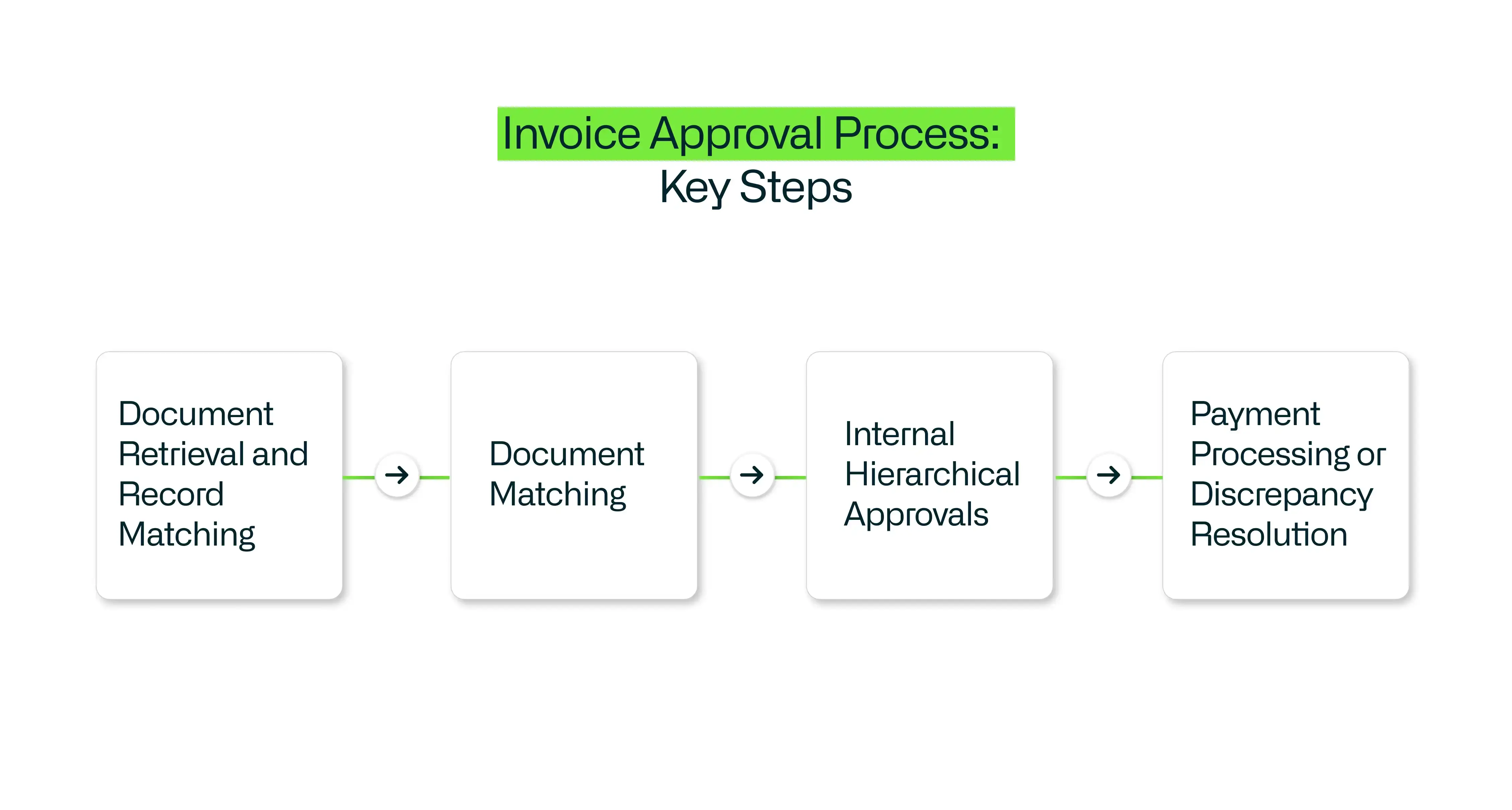
- Step 1. Document retrieval and record matching
The first action to validate an invoice is the retrieval of respective documents to ensure validity of the invoice. This process is dependent on the pre-set record matching process, and requires only a PO in case of 2 way matching, with both PO and GRN are required for the 3 way match.
- Step 2. Document matching
Once the required documents are retrieved, the matching process begins. If anybody the required document or information is missing, it triggers the issue/ exception handling process by which it is enquired, and the payment is kept on hold till resolution.
The documents are matched, and if the match is a success then the invoice may be sent for further approvals. In many cases the invoice may already have been approved before reaching the accounting desk.
However, if there are mismatches, such as in quantity, quality, type or pricing, then the payment is put on hold till the issues are resolved.
- Step 3: 2 way/ 3 way matching by accounting team
After the record matching phase, the next step may be further hierarchical approvals before final payment processing. This step varies in detail and may also have occurred before record matching, depending on internal processes and structures. Typically a signoff is required by the team lead of the team/ department who ordered the goods/ services, followed by a signoff from someone in the finance team.
This step is particularly important to ensure budget compliance and to keep expense planning teams in the loop.
- Step 4. Payment processing or discrepancy resolution
If the invoice passes through all the checks and validations, the vendor payment is processed. Whereas in case of discrepancies, the payment is kept on hold till the issue is resolved or the payment is declined.
In either case, the vendor should be kept informed on the decision and the rationale behind it.
Automating Invoice Approval with Rever
Invoice approval is a necessary but cumbersome process and often adds to manual workload on the finance and accounting teams, apart from the added costs of time and operations.
Rever is a financial automation software that enables enterprises to automate the entire approval cycle, from document extraction, matching, error handling to getting approvals.
Importance of Invoice Approval Process and Management
- Financial accuracy
Financial accuracy depends on ensuring that there are detailed trails of the cash incoming and outgoing from the company. An invoice approval process ensures that every penny that is leaving the company in the form of purchase bills are accurately accounted for, with no room for further doubts from internal or external auditors.
- Bill processing efficiency
Bill/ invoice processing is a big task in enterprises where hundreds of invoices need to be verified and cleared. A well-defined and software-backed bill processing system ensures accuracy in payment processing, saving precious time of the accounting/ finance team and ensuring essential checks and controls on cash outflow from the company account.
- Staying audit and compliance ready
One of the key pillars of enterprise financial compliance and audit-readiness is ensuring that cash outflow from the company is logged and tracked. A robust invoice approval process ensures that your company ledger is clean and all cash outflow is accounted for, preventing any frauds or excess payouts to vendors.
Related: What is Financial Reconciliation?
Best Practices for Invoice Approval in 2026
- Defining protocols and workflow for approvals
Invoice approval begins with a set of protocols and workflows, with the goal of either approving or not approving an invoice received from a vendor. This includes document matching based on 2 way or 3 way matching, and getting sign-offs from the right people. This set of protocols and workflows reflect the company's internal policies of verifications and validation for any invoice, with detailed protocols for handling errors and exceptions.
- Keeping vendors updated on processes and timelines
Vendors/ suppliers are key to enterprise functioning and should be treated with respect and dignity. This includes ensuring that they are made aware beforehand as to what the internal processes are related to invoice generation and clearance, such as invoice data fields, company information to be included, time it takes to process invoices, approximate date of payment etc.
This is especially true for vendors with whom an enterprise may have a long standing working relationship. Getting new vendors is a long drawn process, and keeping existing well-functioning vendors informed about any internal process changes pertaining to them is always a good practice.
- Leveraging automation for invoice verification and record matching
Invoice processing is a time consuming and mechanical process which takes up much of accounting/ finance teams bandwidth. Software like Rever automates the essential manual part of the work, such as record retrieval, document scanning, record matching, approval workflows etc, and keeps the books ready for an accountant/ financial controller. This frees up precious enterprise resources and saves hours and money at the same time.


