01 · CONNECT
Read-only, in an afternoon
Your ERP, your banks, your documents.
Continuous period close by governed AI agents: the checklist sequences itself, drafts accruals and cites flux to its transactions, journals arrive balanced with evidence attached, and nothing posts without human approval.
A growing company carries thousands of monthly transactions into every close, across entities, bank accounts, and processors.
Reconciliations that could have cleared all month land on day one, so the close starts behind
The checklist is a spreadsheet whose real status is whatever the last person to update it remembered
Accruals are rebuilt from scratch each period, because last period's support is scattered
Flux is explained from memory, without the transactions that would settle the question
Your ERP, your banks, your documents.
Your trailing four quarters scanned on day zero, every finding evidenced.
The checklist sequences itself.
Journals arrive evidenced and balanced.
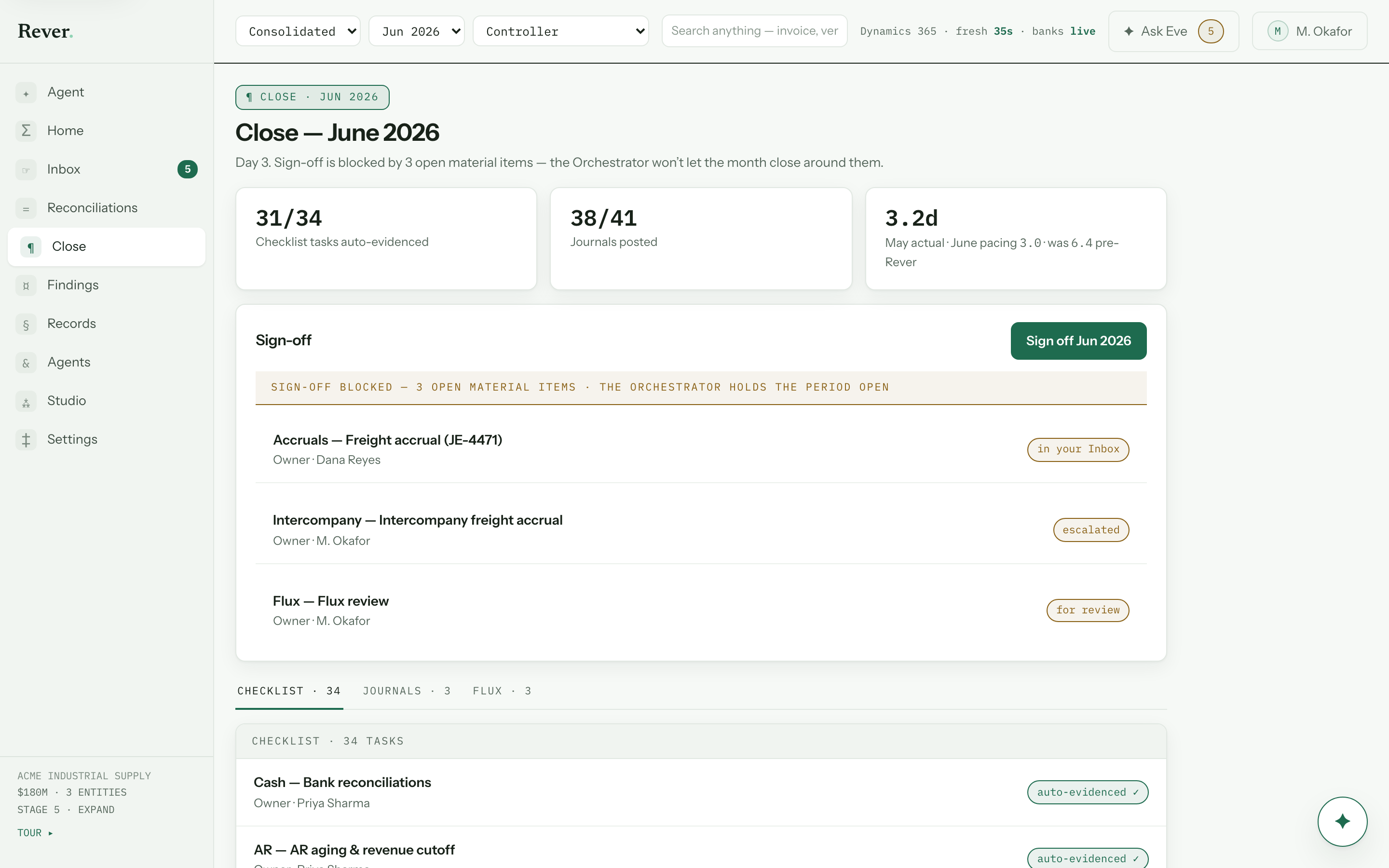
Rever works the close all month.
An explanation is a claim.
Sign-off stays blocked while anything material is open, and only a human lifts a freeze.
Agents prepare entries; only humans post them.
3 governed agents run period close. Each has a narrow charter and a public track record.
sequences the close and blocks sign-off on open items.
prepares balanced entries that post only after approval.
explains movements, every sentence cites its transactions.
| Dimension | Manual, month-end | Rever, continuous |
|---|---|---|
| Checklist | A spreadsheet, updated by hand | Sequences itself as work completes |
| Evidence | Gathered at the end | Attaches as each task finishes |
| Accruals | Rebuilt from scratch each period | Drafted and balanced; your OK posts them |
| Flux | Written from memory | Every sentence cited to its transactions |
| Sign-off | Under deadline pressure | Blocked while anything material is open |
| Audit support | Assembled on request | Exported from the append-only trail |
Software that sequences the month-end checklist continuously, attaches evidence as each task completes, drafts the accruals, and writes the flux narrative with citations. It replaces a deadline scramble with a close that is already assembled when the period ends.
By moving the work off the deadline. Reconciliations clear continuously, accruals draft as their support lands, and the flux narrative writes itself with citations. Day one starts at judgment: the material items, their owners, and your sign-off. That is a 3.0 day close, from 6.4.
No. Agents prepare entries, humans approve them, and only approved entries reach the ledger. Write permission does not exist in agent runtimes, so autonomous posting is structurally impossible, not just switched off.
Bank feeds, Stripe, Microsoft Dynamics 365, QuickBooks, and NetSuite are live. HubSpot and Rippling are shipping soon, with Intacct next. Every plan includes every connector we ship.
Connection is read-only and typically done in an afternoon. The zero-day scan then runs across your trailing four quarters and returns first findings within four hours, each with evidence attached.
Never. Not with consent, not in aggregate. What agents learn from your books serves your tenancy only, and self-hosted deployment is available for teams that keep everything inside their own perimeter.
Bank to books, continuously, across every account.
Fieldwork served from the trail, not from your team's week.
Standing controls that report their own health.
Connect read-only this afternoon. The zero-day scan returns your first evidenced findings within four hours, free.