What is Accounts Payable Management?
Accounts payable management is defined as the end-to-end process of clearing vendor payments through authentication, policy enforcement, approval and payment. It includes defining, creating and updating every stage in the accounts payable workflow.
The purpose of implementing and managing accounts payable is to have a concrete process that self-manages every aspect of vendor payments, starting from how it is received, captured, verified and processed using human and technology resources. This also means that the management team needs to govern how the technology landscape is shaped and how data interacts across systems, while taking into consideration the auditory and regulatory implications.
The benefits of effective accounts payable management for businesses span across finance operations such as preventing vendor billing errors, intercepting fraud/ scam attempts, better vendor relationship management, preventing late payment penalties and compliance and audit readiness.
Related: What is Accounts Payable Automation?
Key Components of Accounts Payable Management Process
To manage accounts payable, the leadership team needs to understand and implement each of the underlying processes that make up the larger management. The protocols need to concretely lay out the outcomes of each process, who is in charge of overseeing it and how issues need to be communicated with the team and vendors.
Let’s deep dive each:
- Step 1: Vendor invoice capture
The workflow for capturing vendor invoice defines how the invoice is sent, detected and picked up for further processing by the accounting/ finance team. Typically, all invoices today are shared via email, in large enterprises the enterprise resource planning (ERP) system captures it and the accounting team gets notified to pick it up for processing.
- Step 2: Invoice authentication and validation checks
At the center of accounts payable, is the methodology and acute verification of the documentation behind the vendor invoice. This means extracting the purchase order (PO) document and matching it with the invoice, line by line. The standard checks include documentation IDs, product/ service name, quantitative and qualitative aspects, price and calculation.
Today, most large businesses use the more sophisticated 3 way match process of including an internal good received note (GRN) into the mix. This helps ensure that product/ service delivery was also done as expected and adds a key verification needed in large business settings.
Related: What is Invoice Management?
- Step 3: Approval workflows
Post-documentation matches, depending on the scale of operations, the next layer is a series of sequential approvals that the accounting team needs to implement. This layer of approvals is meant to apply senior level control, where team leads verify the match data, perform internal team level checks and give their sign-offs.
Related: What is Invoice Approval Workflow?
- Step 4: Exception and issue handling protocols
As and when exceptional situations or issues arise with payable operations, the team should have a ready playbook for seeking resolutions and escalating when needed.
For example, a vendor may be facing insolvency issues and is asking for an exceptional early payment release for goods supplied so far. Such a situation may be dealt with through the right channels of communication involving the right stakeholders and decision makers.
- Step 5: Audit and regulatory compliance
The accounting team is also responsible for ensuring that the right audit trail is in place and that all regional/ national compliances are in place. In the case of international vendors, the right method of payment in accordance with cross-national trade laws need to be checked and abided. Much of this would have already been noted while the supply deal was being drawn.
- Step 6: Payment cycles and modes
The final payment to the vendor is scheduled based on agreed upon cycles. Typically its a monthly cycle, in some cases it could be weekly. The payment is disbursed to the vendor based on mutually accepted modes, with a standard online transfer being the most common. This ensures that the data trail is readily available for audit purposes.
- Step 7: Final payment
The final payment is disbursed to the vendor on schedule and on time. This is key for ensuring timely payment so as to not draw any late payment fees. Once the vendor is paid, the accounting books need to be updated.
- Step 8: Reconciliation and closure
Payable reconciliation takes place based on set accounting schedules, typically every quarter. During this critical phase, all the documentation from order placement to vendor payment is checked, verified and if successful, the books are closed.
Related: 15 Ways Accounts Payable Automation Can Improve Cashflow Forecasting
Importance of Accounts Payable Management
Accounts payable management is an essential enterprise process that serves multiple areas. Here are the details:
- Cornerstone for supply chain management
For the supply chain to continue functioning smoothly, it depends on ongoing and timely supplier invoice clearances. Effective accounts payable management ensures that the supply chain process never gets interrupted by overdue payments, which can lead to vendors pausing supplies.
- Cordial vendor relationship management
Trusted and long standing vendor partnerships are a key pillar for organizational scaling and growth. It directly affects cashflow as these supplies in turn create business output in the form of goods/ services. Through investing in building a reliable accounts payable ecosystem, businesses in turn are able to ensure that their own production lines continue to receive uninterrupted supplies from vendor partners.
- Error and fraud/ scam detection
The payable process applies critical checks and controls that catch errors and prevent fraud/ scam attempts from succeeding. The methods used for document scanning, line item matching, approval chain etc, are layers of validation that are designed for early issue detection and escalation where needed.
- Effective working capital and budget management
Working capital depends on cashflow, budget and expenses. Accounts payable provides the key dataset on vendor expenses, which in turn plays into all kinds of financial projections, one of them being working capital.
Furthermore, if vendor expenses are approaching a budget threshold, accounts payable team is expected to escalate and inform the right stakeholders for review and resolution.
- Business efficiency and audit readiness
Accounts payable affects business efficiency through its error and fraud detection, avoiding overdue penalties, role in financial forecasting and contribution in maintaining a healthy supply chain.
The payable team also ensures that the right method of payment and data trail are in place in accordance with meeting all audit and compliance needs.
Related: What is Accounting Automation?
Best Practices for Accounts Payable Management in 2026
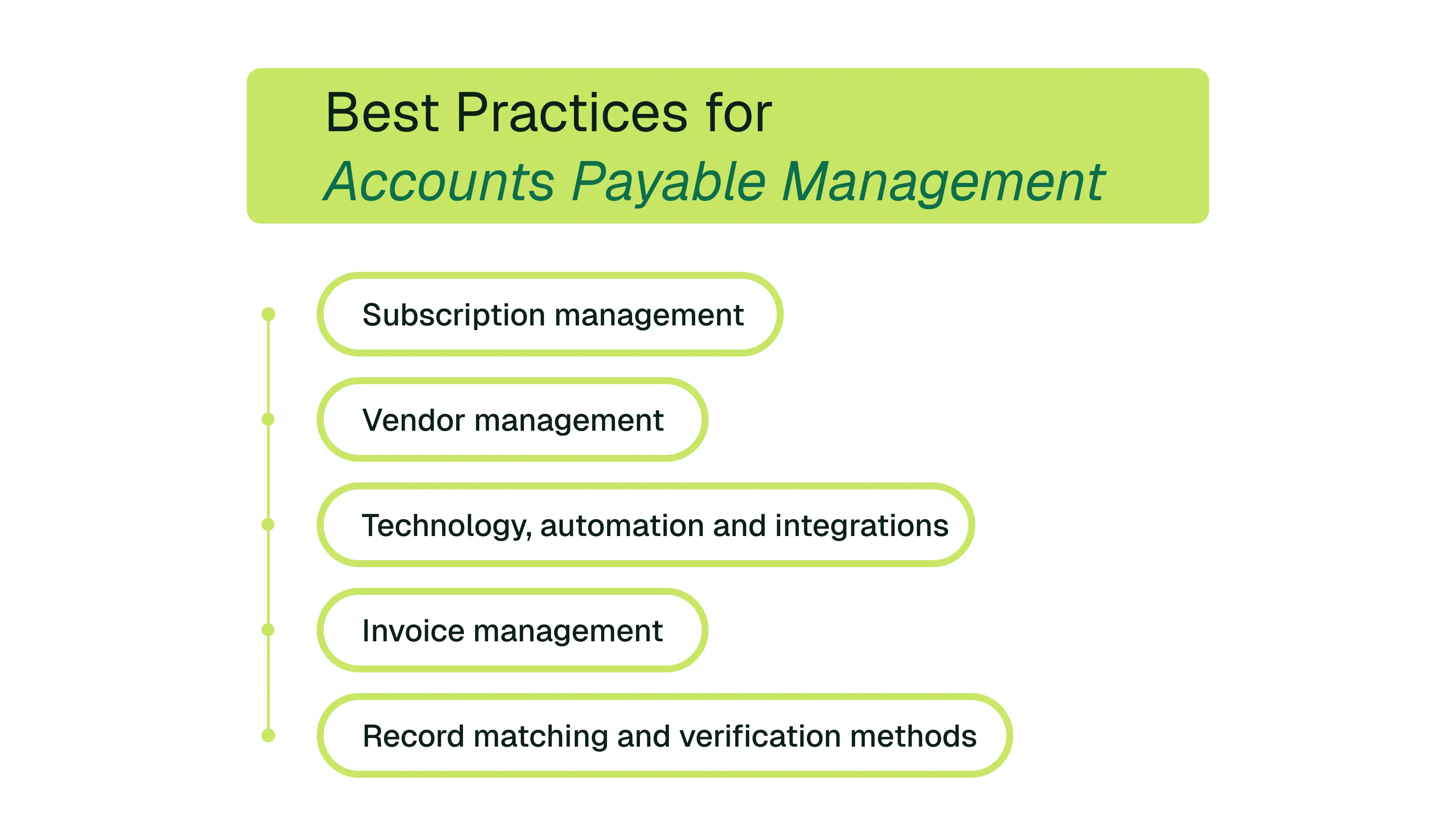
Here are the key best practices for accounts payable management in 2026:
- Subscription management
Periodic review of all payable subscriptions such business tools and technologies, office supplies, production line requirements etc ensures that all such expenses are in line with actual needs and not over estimated.
Especially for online tools, often subscription payments carry on while the payable team assumes they are being used, while in reality efficient use remains low or negligible. In large enterprises, it is not uncommon for multiple tools to be subscribed to which have several overlapping features. Such periodic payable subscription analysis can help cut down significant operations cost.
- Vendor management
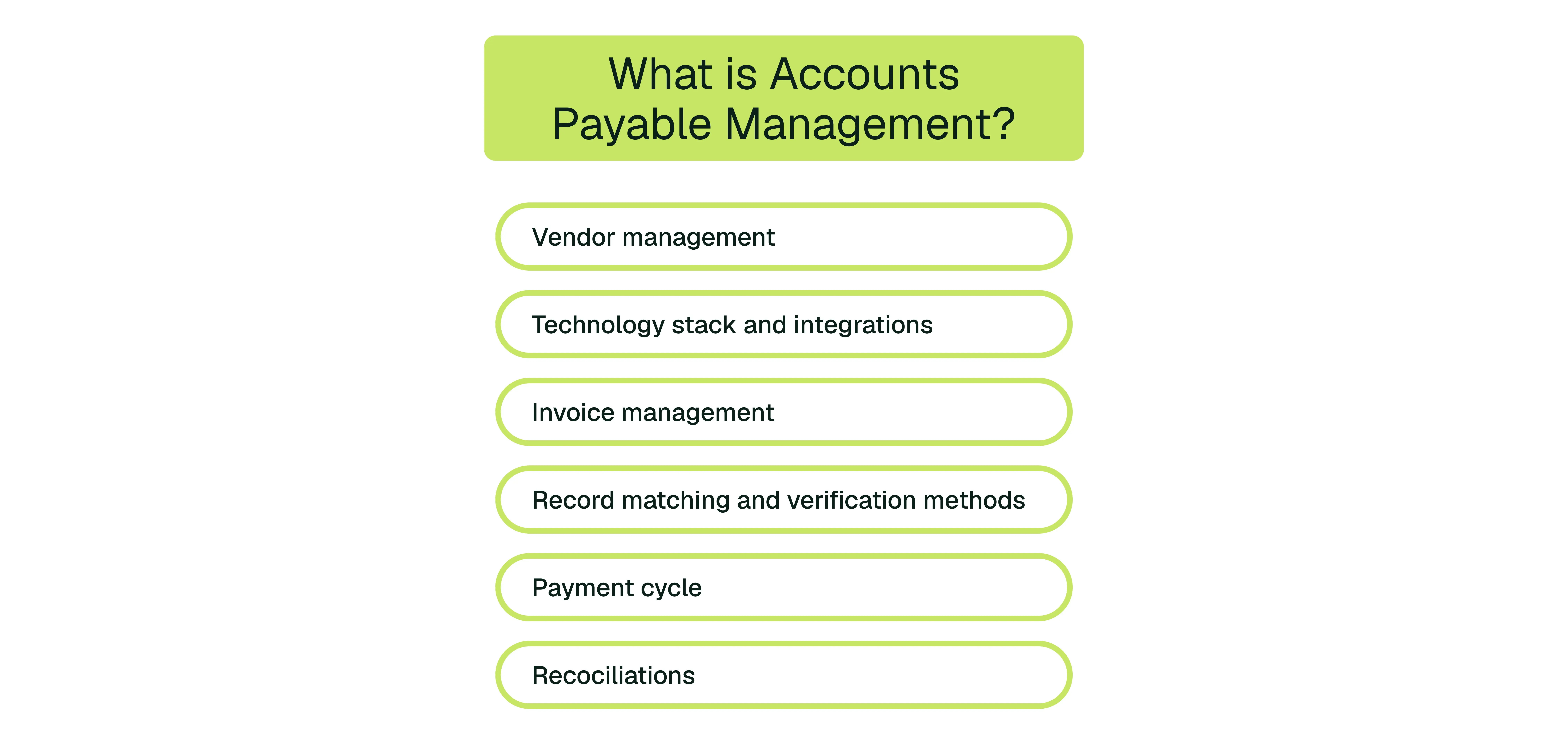
Purchase and payable are the key contributing teams to vendor management, as one procures the supplies and the latter ensures timely payments.
Payable vendor management practices should ideally include proper communication of payment cycles, mode of payment, regulatory/ tax components, company registration/ documentation details, payment received confirmation and statement collection for reconciliation.
- Technology, automation and integrations
Payable teams require technologies to function efficiently and deliver optimum results. Depending on team strength and company operations intensity, various types of tools and software can be used. Accounts payable automation today enables companies to streamline key data intensive and repetitive tasks such as document scanning, record extraction and matching, approval workflows etc.
Above all, any new technology addition needs to integrate seamlessly with existing enterprise/ business platforms such as the enterprise resource planning (ERP) system, CRMs and other financial/ accounting tools already in play.
- Invoice management
About 70% of payable management is actually invoice management. Protocols for invoice management therefore play a big role in overall accounts payable, setting the journey from invoice capture to clearance.
Concrete definition of each phase of the invoice journey within the organization, including technology, methodologies and approval sign offs by stakeholders, can in turn streamline a large portion of accounts payable management.
- Record matching and verification methods
Verifications, validation and reconciliation methods are essential aspects of applying financial checks and balances. Setting up record matching methodology, such as 2 way matching or 3 way matching, approval workflows, escalation matrix, issue handling protocols etc go a long way in implementing and managing accounts payable.