
What is 2 Way Matching?
2 way matching is defined as an invoice validation process for verifying vendor invoices, by matching them with the corresponding purchase order (PO) document. This process is used for invoice processing of goods or services purchased on credit/ post-pay terms from vendors, for which they raise invoices after delivery is completed.
The purpose of a two way match is to ensure that vendor invoices are valid and accurate in accordance with what was raised in the PO, thereby preventing incorrect billing. If the match process is a success, invoice validation is complete and the accounting team initiates the remainder of the approval workflow. Whereas, in case of a mismatch the issue is investigated for resolution and further steps for invoice approval are halted.
For example, a team in a company requires a new software that is to be billed on a post-paid monthly cycle. After vendor selection and deal finalization, a purchase order (PO) is created and sent to the vendor. This PO document entails the details of the item to be purchased, at what price, when and how much. At the time of the monthly payment, the invoice is generated by the vendor company. This invoice is then received by the accounting team for verification against the initial purchase order and matched for validity and accuracy in a 2 way match.
Rever enables businesses to the automate the accounts payable processes, including 2 way matching, where every invoice is automatically captured, matched, and verified in real-time.
Related: What is 3 Way Matching?
Key Components in a 2 Way Match
2 way match has two core components - the purchase order and the vendor invoice.
For enterprises, the data of both these components typically rest in the Enterprise Resource Management (ERP) system or accounting software. Let us dig deeper into both these components and how they flow through typical enterprise operations:
- Purchase order:
The purchase order (PO) is generated by the company that has decided to make a purchase from a vendor on credit basis. This document is shared with the vendor and the delivery is expected based on the requirements detailed here. The timeline of credit to payment is based on agreement between the company and its vendor and is typically monthly or quarterly.
- Vendor invoice:
Vendor invoices are raised by seller of goods/ services with the company who purchased on credit based on agreement. This invoice is received and then processed by the accounts payable team, through record matching, approvals and final payment scheduling.
- Validation process:
The invoice validation process first checks the invoice itself for completeness, such as valid company details, tax information, currency, calculations etc. Once this layer of checks is a success, the 2 way match or 3 way match process begins, depending on set policies.
Let's take an example of a manufacturing company, where a new raw materials agreement is signed with a vendor. As per documented agreement, a monthly billing cycle is set. For each new requirement a purchase order is documented and shared with the supplier. After delivery, the total invoices are shared by the vendor with the company for payment. The company then uses 2 way match process to validate each invoice.
Related: What is Invoice Management?
2 Way Match Process: Key Steps
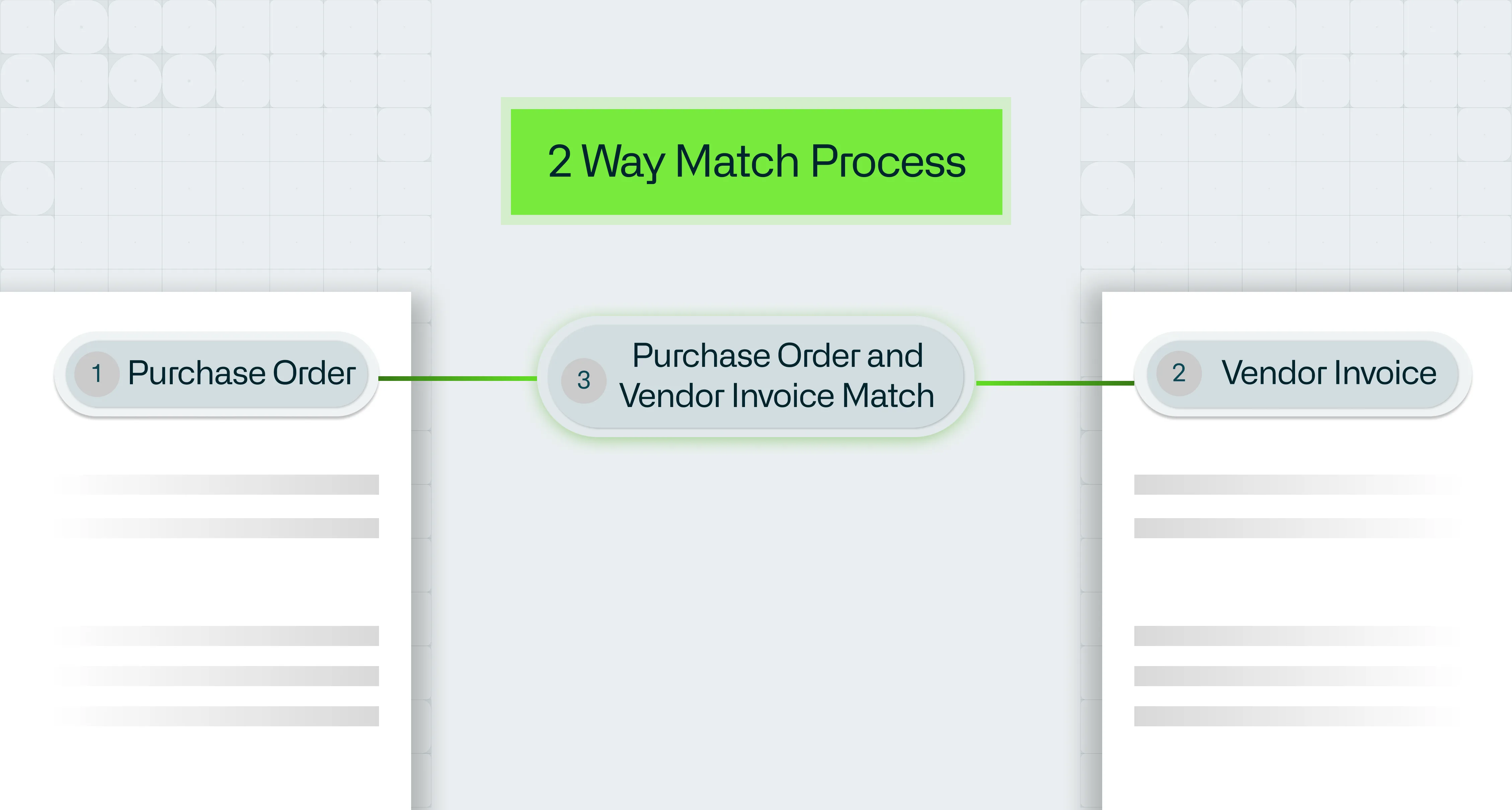
The 2 way match process is triggered when accounting team receives a vendor's invoice for payment. Here are the key steps in this process:
- Step 1: Purchase order (PO) extraction based on vendor invoice
The two way match process is triggered when the business receives a vendor invoice. The accounts payable team extracts the corresponding purchase order (PO) based on header details in the invoice. For enterprises, the PO is typically captured and stores in an enterprise resource planning (ERP) or finance/ accounting software. If the purchase order is not found, the invoice is deemed invalid even before a match and the issue may be investigated.
- Step 2: Purchase order and vendor invoice match
Once the purchase order is extracted, the vendor invoice is matched line-by-line for accuracy based on what was ordered and what is being billed for payment. In case of a discrepancy, an investigation is launched to understand the error. In case of a match success, where no issues are found, the invoice is authorized for further approvals.
- Step 3: Invoice approval
The matched invoice is sent for approval based on set workflows and protocols. Typically, it requires sign-off by key stakeholders such as lead of the team who utilized the goods/ services, accounting/ finance head etc.
- Step 4: Payment processing
Payment processing of matched and approved invoices are scheduled based on the agreed upon payment cycle agreements with vendors, typically monthly or quarterly.
Related: What is Financial Reconciliation?
Benefits of Using a 2 Way Match Process
Two way matching provides several significant benefits for enterprise accounts payable accuracy:
- Reduced invoice errors
The matching process helps identify discrepancies between the purchase order and invoice, such as incorrect quantities, pricing differences, or unauthorized charges. This reduces the likelihood of inaccurate invoices being approved and paid, thereby reducing potential financial leakages.
- Simplified accounts payable workflows
2 way matching involves fewer validation steps in comparison to 3 way matching, as it does not require a goods receipt note (GRN) document. This makes the process particularly useful for purchases where receipt confirmation is not necessary or where the purchase order itself provides sufficient validation.
- Faster supplier payments
A structured invoice validation method allows for faster processing using pre-defined methodology, thereby reducing/ eliminating payment delays and overdue charges. Faster processing can also help organizations take advantage of early-payment discounts and maintain stronger supplier relationships.
- Greater visibility into discrepancies
When invoice information does not match the purchase order, the system can flag the exception for investigation. This allows accounts payable teams to focus their attention on problematic invoices instead of manually reviewing every transaction.
- Easier automation and scalability
2 way matching is well suited to accounts payable automation because invoice and purchase order data can be captured and compared electronically. As invoice volumes grow, organizations can process more transactions without relying heavily on additional manual resources.
- Improved audit readiness
A documented 2 way matching process creates an audit trail showing that invoices were checked against approved purchase orders before payment. This provides greater transparency and supports internal controls over accounts payable.
Related: What is Accounts Receivable?
Potential Challenges of 2 Way Matching
While the 2 way process clearly has some key benefits, it is not a fully sealed process and has some gaps:
- Limited verification of goods or services received
2 way matching compares the invoice against the purchase order but does not verify whether the goods or services were actually received. This can create a risk of paying for items that were not delivered, were partially delivered, or did not meet the required specifications.
- Higher risk for quantity discrepancies
Since there is no goods receipt document involved, the process may not identify situations where the supplier invoices for a quantity that differs from the quantity actually received. This makes 2 way matching less suitable for purchases where delivery quantities need to be closely monitored.
- Dependence on accurate purchase orders
The effectiveness of 2 way matching depends heavily on the quality and accuracy of purchase order data. Incorrect prices, quantities, supplier details, or payment terms in the purchase order can result in incorrect matches or allow inaccurate invoices to pass validation.
- Not suitable for all types of purchases
2-way matching works best for straightforward purchases where the purchase order provides sufficient evidence for invoice validation. Complex purchases, inventory-intensive transactions, or purchases requiring physical receipt confirmation may require 3 way matching instead.
- Potential for unauthorized payments
If an invoice references a legitimate purchase order but the underlying goods or services were never received, 2 way matching may still approve the invoice. Additional controls may therefore be necessary to confirm that the transaction is genuine and authorized.
Best Practices for 2 Way Matching
- Setting detailed purchase order formats
The first step to ensure an effective 2 way match process is to have detailed, pre-set and mandatory fields for raising a purchase order. This ensures that all essential fields of data capture are present when a PO is processed, such that it leaves no room for quantity, quality or pricing related discrepancy during 2 way match when the vendor invoice is received.
- Define clear matching tolerances
Establish acceptable tolerance limits for differences in invoice prices and quantities. For example, an organization may allow a small price variance between the purchase order and invoice while automatically routing larger differences for review.
- Automate invoice and purchase order matching
Use accounts payable automation to capture invoice data and automatically compare it with purchase order information. Automated matching can reduce manual data entry, accelerate invoice approvals, and identify exceptions more consistently.
- Setting exception handling process
An exception handling process is required for escalating, responding and managing cases of fraud, errors or situations that require involvement of other stakeholders. Clearly defining an invoice approval workflow can help with the management of exceptions and adhoc issues that may crop up with supply chain invoice management.
- Establish exception-handling workflows
Define clear procedures for invoices that fail the 2 way match. Exceptions should be automatically routed to the appropriate buyer, department manager, or finance team for investigation and resolution rather than remaining stuck in the accounts payable queue.
- Use additional controls for receipt-sensitive purchases
2-way matching should not be the only control for purchases where physical delivery or service completion is important. For inventory, high-value purchases, or delivery-sensitive transactions, organizations should consider additional receipt confirmation or 3-way matching.
- Prevent duplicate and unauthorized invoices
Combine 2 way matching with duplicate invoice detection, supplier validation, purchase order approval, and authorization controls. These additional checks help prevent legitimate-looking invoices from being paid more than once or without proper approval.
- Monitor matching performance
Track metrics such as match rates, exception rates, invoice processing time, and invoices requiring manual intervention. Regular monitoring helps identify recurring problems with suppliers, purchasing processes, or purchase order accuracy.
- Keep a complete audit trail
Maintain records of the purchase order, invoice, matching results, approvals, exceptions, and resolution activities. A clear audit trail improves financial control, accountability, and audit readiness.
- Regularly review and optimize matching rules
Periodically evaluate matching tolerances, approval rules, exception categories, and supplier-specific requirements. Updating these rules based on actual transaction patterns can improve automation while maintaining appropriate financial controls.
- Setting financial tolerance threshold based on budget
Setting a financial tolerance limits based on the company's budget helps prevent any significant straying away from the expense plan. In case of purchase requirements that cross the set tolerance threshold, they can be sent through an exception handling process for approval or rejection.
- Ensuring reliability of data storage and retrieval systems
Both purchase orders and vendor invoices need to be stored in such a way that they can be easily extracted for matching and reconciliation.
At the very minimum, strong authentication based access and retrieval data systems should be used. And on an advanced level, Rever provides multi-layered data protection for storage and retrieval, and automation of the accounts payable process.


